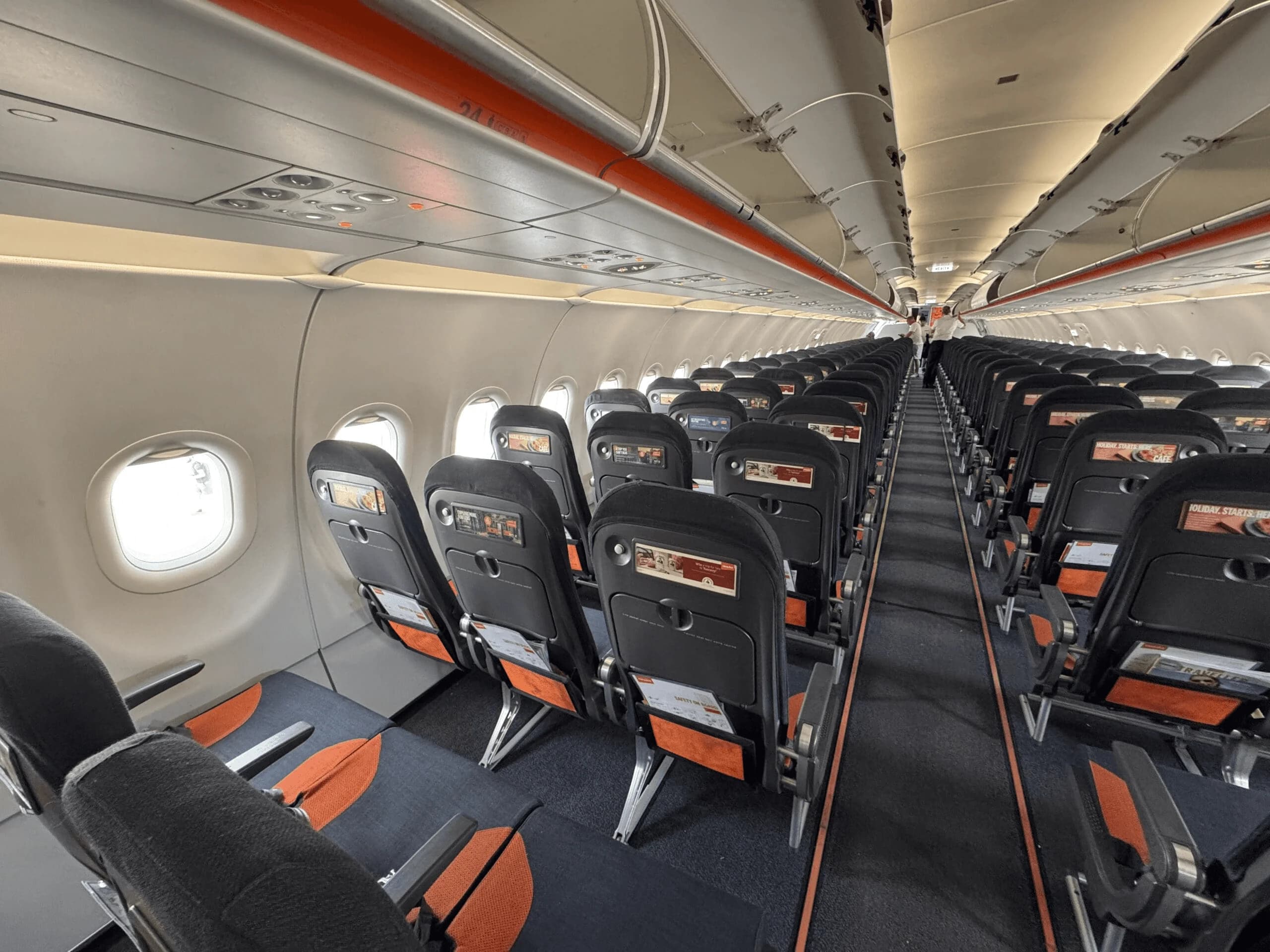
easyJet's Airbus A320 features a single-cabin 3-3 layout with standard economy seating. The airline offers Extra Legroom seats in select rows with increased pitch for passengers prioritizing comfort on short to medium-haul European routes.
TL;DR
The A320 is configured in a 3-3 economy layout with 29" standard pitch. Rows 1, 12, and 13 offer XL Extra Legroom seats with approximately 35" pitch - the best choice for taller passengers. Avoid standard-pitch rows if legroom is your priority, and note that no business class is available on this aircraft.
Business Class
Not available. easyJet operates the A320 as an all-economy aircraft with no premium cabin.
Economy Class
The A320 is configured with 3-3 seating (ABC - DEF) throughout the cabin. Standard economy seats offer 29" (74 cm) pitch, which is tight for longer flights. easyJet's XL Extra Legroom seats, found in rows 1, 12, and 13, provide approximately 35" (89 cm) pitch. Seat width is 17.7" (45 cm) across all economy seats. Exit row seats (typically rows 12 and 13) also feature extra legroom. Seats near emergency exits may have restricted recline or limited storage due to safety regulations.
Best seats
Seat
Cabin
Why
1A, 1C, 1D, 1F
Economy (XL Extra Legroom)
Bulkhead row with maximum legroom (~35"), ideal for tall passengers and early cabin access
12A - 12F, 13A - 13F
Economy (XL Extra Legroom)
Exit row seats with extra pitch (~35"), good legroom without bulkhead proximity
Seats to avoid
Seat
Cabin
Why
Standard pitch rows (2 - 11, 14+)
Economy
Limited legroom (29") makes these uncomfortable for tall passengers on medium-haul flights
Seats in front of emergency exits
Economy
Reduced recline and potential overhead bin restrictions due to safety requirements
Last rows
Economy
Proximity to lavatories and galley may cause noise and traffic disruption
💰 The True Cost Breakdown
easyJet charges €15 - 25 for standard seat selection depending on route length and timing, with front rows (1 - 6) commanding the premium end. Exit row seats (rows 12 - 13) cost similarly but deliver the XL pitch benefit without the "front of cabin" premium. A round-trip seat selection for two passengers can easily add €60 - 100 to your fare, making it a significant uplift compared to legacy carriers where premium economy is often included - though easyJet's base fares are typically 40 - 50% cheaper to begin with, so the total cost remains competitive even with add-ons.
📐 The Space Reality
Standard economy seats measure exactly 29 inches (74 cm) pitch with 17.2 inches (44 cm) width, making them noticeably cramped on flights over 4 hours; Ryanair's 737-800 offers identical pitch but slightly narrower width, so there's no meaningful difference between these two ultra-low-cost leaders. The slimline seats feel genuinely tighter than legacy carrier economy due to thinner padding and minimal recline (7 inches), and a 13-inch laptop requires careful positioning on the tray table, which pulls down just 6 inches from the seat. The XL Extra Legroom seats (35 inches pitch) transform the experience, making them worth the upgrade for anyone over 6 feet or on flights exceeding 3 hours.
⚡ Power & Connectivity Reality Check
USB-A outlets are absent from standard economy seats; only some XL Extra Legroom rows feature them, forcing most passengers to rely on personal battery packs. easyJet offers WiFi via Intelsat satellite (not air-to-ground), available as a paid add-on (around €7 - 8 per flight), with real-world speeds typically 2 - 4 Mbps - adequate for messaging and light browsing but unsuitable for video streaming or large file transfers. Bring a fully charged 20,000 mAh power bank if flying beyond 3 hours, as the flight duration guarantees at least one passenger will need an emergency charge.
🏃 Boarding & Exit Strategy
easyJet uses open seating on most routes (assigned seats cost extra), creating a first-come-first-served boarding free-for-all that rewards early check-in; if you've paid for a specific seat, you board in your assigned group (typically 15 - 20 minutes before departure). The rear of the cabin (rows 24 - 30) deplanes fastest because the back door opens immediately after front-door passenger flow clears, shaving 3 - 5 minutes versus exiting from row 1. For tight connections under 90 minutes, avoid rows 15 - 20 (the aircraft's widest congestion point) and aim for rows 1 - 5 or 28 - 30 to minimize cabin queue time.
FAQ
Does easyJet's A320 have business class?
No, the A320 is operated as an all-economy aircraft by easyJet. There is no premium cabin on this aircraft type.
What is the difference between standard and XL Extra Legroom seats?
Standard economy seats have 29" (74 cm) pitch, while XL Extra Legroom seats offer approximately 35" (89 cm) pitch. XL seats are typically located in rows 1, 12, and 13 and are available for purchase at an additional cost.
Which seats have the most legroom?
Row 1 (bulkhead) and rows 12 - 13 (exit rows) offer the most legroom at approximately 35" pitch. These are the best options for tall passengers or those prioritizing comfort.
Is there extra legroom in exit rows?
Yes, exit row seats (typically rows 12 and 13) feature extra legroom comparable to XL seats. However, these seats have restrictions on recline and may have limited overhead storage due to safety regulations.
What is the seat width on the A320?
All economy seats on the A320 are 17.7" (45 cm) wide. This is standard for the 3-3 layout and is consistent across the cabin.
Can I recline my seat on easyJet's A320?
Standard economy seats have limited recline. Exit row and certain reserved seats may have restricted or no recline due to safety requirements.