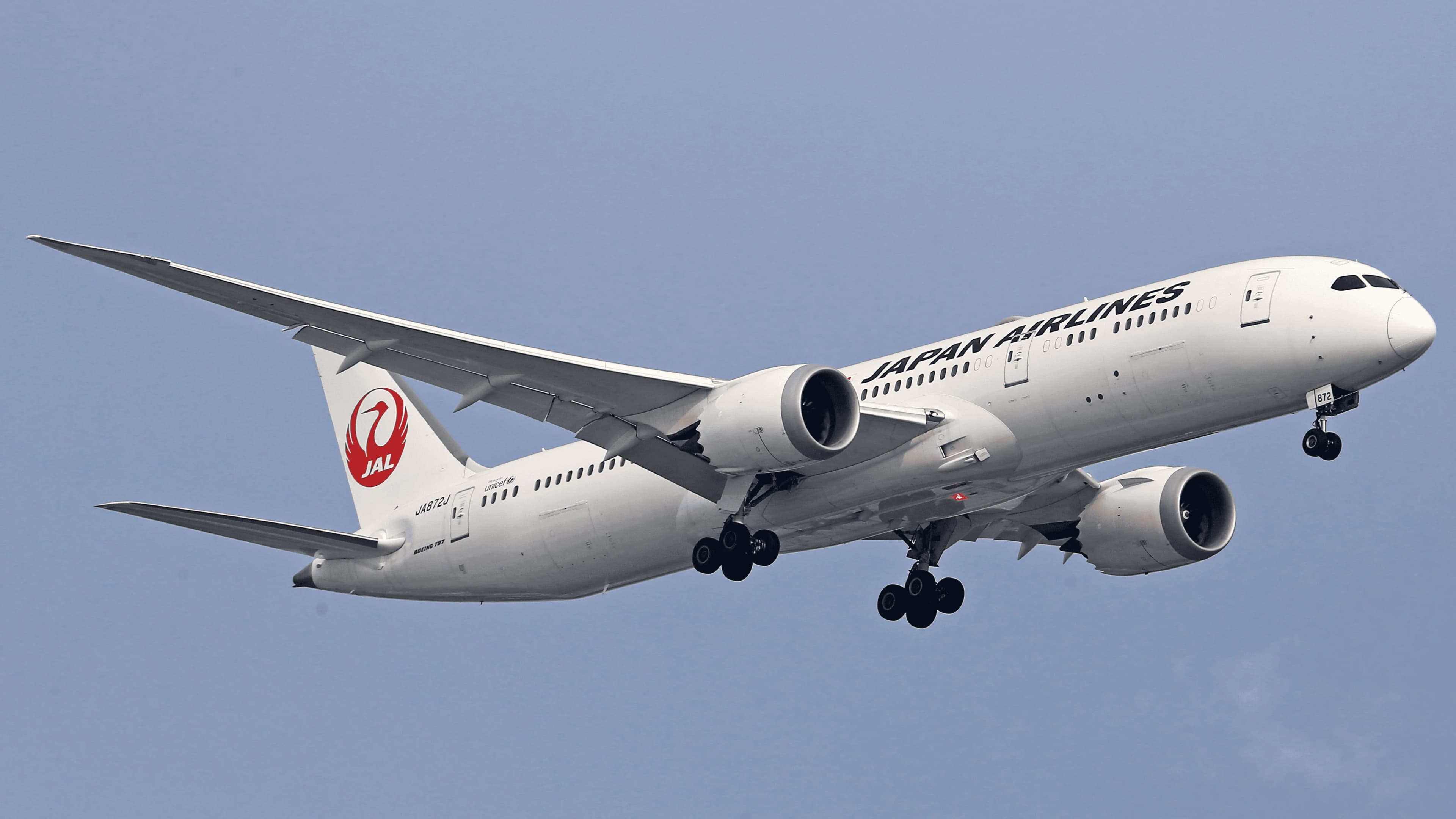
The Boeing 787-9 is Japan Airlines' flagship widebody aircraft, featuring premium SKY SUITE business class with direct aisle access and a spacious 3-3-3 economy cabin. Discover which seats offer the best comfort and which to avoid on this modern Dreamliner.
TL;DR
Japan Airlines operates the 787-9 with two business class products: SKY SUITE III (1-2-1 layout) offering maximum privacy, and SKY SUITE (2-2-2 layout) providing direct aisle access. Best business seats are window pairs in rows 3-7, while premium economy row 17 offers superior comfort. Avoid the last business row and final two economy rows due to limited amenities and galley proximity.
Business Class
Japan Airlines offers two distinct business class experiences on the 787-9. The SKY SUITE III features a premium 1-2-1 configuration with direct aisle access for all passengers, located in rows 1-9 on some aircraft variants. The SKY SUITE uses a 2-2-2 layout, found in rows 1-13 on certain configurations. Both products feature lie-flat seats, though SKY SUITE III provides enhanced privacy with its single-seat configuration on the cabin sides.
Premium Economy Class
Premium Economy is strategically positioned around row 17, offering enhanced comfort with increased pitch and width compared to standard economy. This cabin provides better amenities, priority boarding, and improved meal service, making it an excellent value alternative to business class on long-haul routes.
Economy Class
The economy cabin features a standard 3-3-3 seating configuration, providing comfortable dimensions for long-haul flights on the 787-9. The Dreamliner's larger windows, improved cabin pressure, and enhanced humidity create a superior economy experience. Standard economy seats are found throughout the rear sections of the aircraft, with varying comfort levels depending on proximity to galleys and lavatories.
Best seats
Seat
Cabin
Why
3A, 3K, 4A, 4K, 5A, 5K, 6A, 6K, 7A, 7K
Business (SKY SUITE III)
Window seats with optimal privacy, away from galley and entry disturbances
A, C, H, K pairs
Business (SKY SUITE)
Paired seats for travelers together, direct aisle access in 2-2-2 layout
17A, 17C, 17H, 17K
Premium Economy
Forward positioning offers superior service priority and cabin access on E92
17-19 (all seats)
Premium Economy
Forward premium economy block provides best amenities on E91/E71 variants
Seats to avoid
Seat
Cabin
Why
7 (E92), 13 (E91)
Business
Last business row transitions to premium economy, galley and service disruptions
58-59
Economy
Last rows lack overhead storage, limited recline, proximity to rear lavatories and galley
Middle seats (B, D, E, F, G, I, J)
Economy
Less desirable in 3-3-3 layout; aisle and window seats preferred for space perception
✈️ The Version Lottery
Japan Airlines operates at least three distinct 787-9 cabin configurations, primarily differentiated by SKY SUITE III (1-2-1, rows 1-9) versus SKY SUITE (2-2-2, rows 1-13), with some aircraft featuring the older SKY SUITE II layout entirely. Identify your aircraft via the JAL booking reference or by checking SeatGuru's specific flight tracker - the seat map reveals configuration immediately, and this matters significantly for aisle access and privacy. If your booked flight assigns a middle seat in SKY SUITE 2-2-2, requesting a schedule change to a SKY SUITE III departure is worth a phone call to JAL; the experience difference justifies minor inconvenience, especially on transpacific routes where the direct-aisle setup eliminates neighbor disturbance.
🏆 The Competitive Verdict
Against ANA's 787-9 Throne Class (also 1-2-1) on equivalent Tokyo routes, JAL's SKY SUITE III trades slightly inferior cabin lighting design for marginally superior meal presentation and more consistent seat pitch; ANA wins decisively for solo travelers seeking pure isolation, while couples find negligible difference. For tall passengers (6'2"+), both are functionally identical at 6'8" lie-flat length. Cathay Pacific's 1-2-1 on the same aircraft genuinely outperforms JAL in mattress quality and amenity kit, making it the better choice if both are available and pricing is comparable; however, JAL's ground service and hub efficiency tip the balance for connecting passengers.
🛁 Lounge & Ground Experience
JAL's home hub is Narita or Haneda (depending on your route), where First Class passengers access the JAL First Class Lounge with shower suites, à la carte dining, and quiet rest areas; Business Class passengers use the JAL Business Class Lounge, which offers showers and light meals but lacks the spa-grade amenities. Business Class access is automatic with any paid premium cabin ticket; First Class access requires F cabin booking. Routing via Haneda over Narita adds 15 - 25 minutes of connection time but delivers a materially superior lounge environment and shorter immigration queues, justifying a deliberate hub preference if your origin permits flexibility.
🌙 The Overnight Formula
For transpacific red-eyes, book any aisle-access SKY SUITE III seat (rows 2, 4, 6, 8 in column A or F for maximum privacy), decline the multi-course dinner service to sleep immediately after boarding, and bring a neck pillow and compression socks - JAL's seat recline and mattress pad are sufficient without additional bedding. Eat the light breakfast service 90 minutes before landing to reset your circadian system; arriving in Tokyo rested beats arriving fed. Set the seat to full flat immediately after pushback, dim your cabin light, and ignore the 11-hour daytime window outside - aggressive early sleep is the only optimization that matters.
FAQ
Does the Boeing 787-9 have premium economy?
Yes, Japan Airlines includes a premium economy cabin on the 787-9, typically positioned in row 17 (E92) or rows 17-19 (E91/E71) depending on aircraft configuration. It offers enhanced comfort with better pitch, wider seats, and improved meal service.
What's the difference between SKY SUITE III and SKY SUITE?
SKY SUITE III features a 1-2-1 configuration with single seats on the cabin sides, offering maximum privacy and direct aisle access for all passengers. SKY SUITE uses a 2-2-2 layout with paired center seats, also providing direct aisle access but in a more social configuration.
Are there privacy doors in business class?
No, neither SKY SUITE III nor SKY SUITE configurations feature privacy doors. However, SKY SUITE III's 1-2-1 layout provides enhanced privacy through its single-seat design on the cabin perimeter.
Which seats have the best window views?
Window seats (A, K in SKY SUITE III; A, K in SKY SUITE) offer unobstructed views. In business class, rows 3-7 are ideal as they avoid entry areas while providing optimal viewing angles over the wing.
Is the middle seat in economy acceptable?
The middle seat (B, D, E, F, G, I, J) in economy's 3-3-3 layout is less desirable but acceptable. Window and aisle seats are preferred for better space perception and easier lavatory access. Premium economy is recommended for better comfort.
What's the pitch in business and economy?
While specific pitch measurements aren't provided, SKY SUITE business seats feature full lie-flat capability. Economy maintains standard widebody dimensions suitable for long-haul comfort on the modern 787-9.