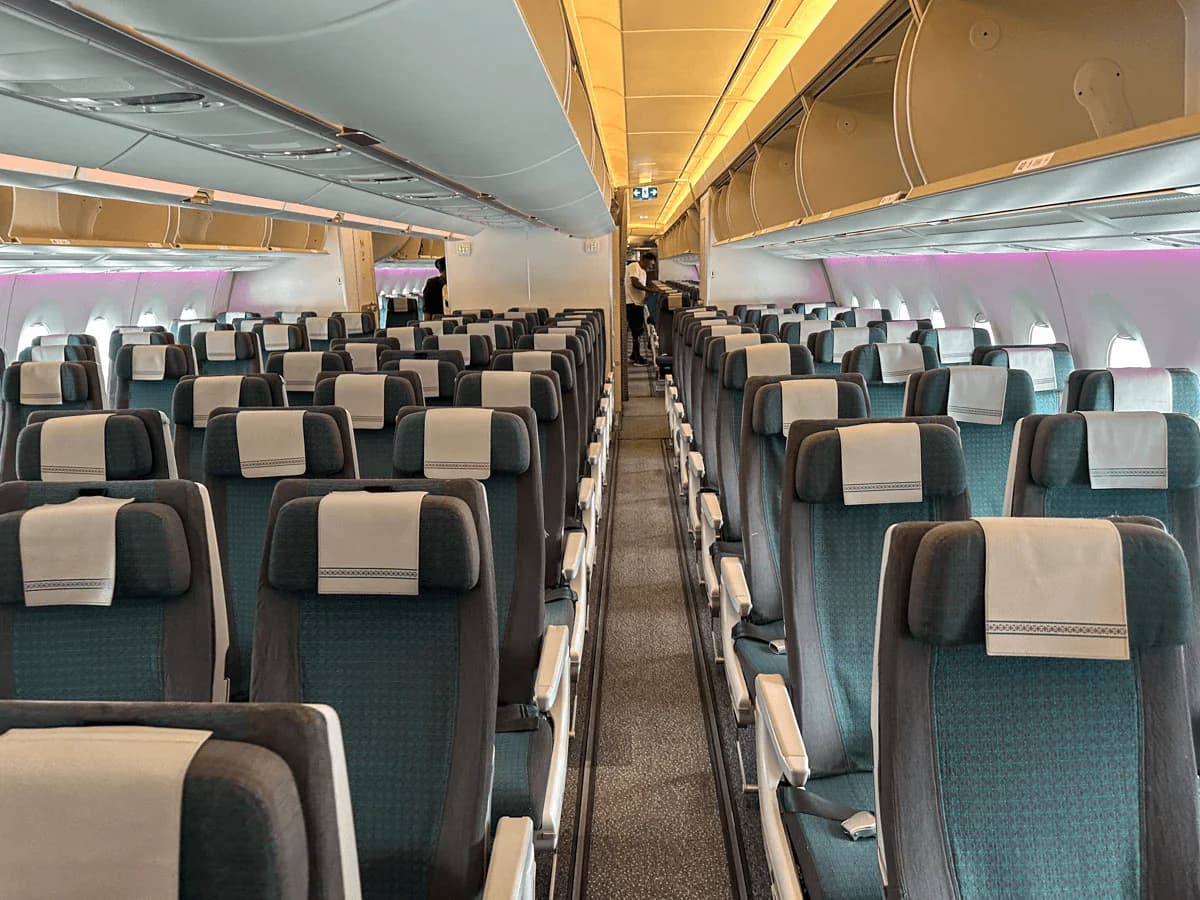
The Fiji Airways A350 offers a premium long-haul experience with spacious Business Class and comfortable Economy options. This guide reveals the best and worst seats across both cabins to maximize your comfort on tropical routes.
TL;DR
Fiji Airways' A350 features a 4-seat Business Class and 3-3-3 Economy layout. Book Business window seats (A or K) in mid-cabin even-numbered rows for optimal privacy and space. In Economy, target Bula Space rows 31-35 (34-inch pitch) or bulkhead positions, and avoid middle seats, rear lavatories, and the final rows where comfort drops significantly.
Business Class
Business Class features a 4-seat 2-2 layout across 21 rows with seats arranged as A (window), D (center), G (center), K (window). This configuration provides direct aisle access for all passengers. Mid-cabin seats in even-numbered rows offer the best balance of privacy and proximity to amenities, away from forward and aft galley activity. Avoid front row D and G seats due to galley proximity, and rows 21 D and G seats which face the rear galley and lavatory areas.
Economy Class
Economy Class uses a standard 3-3-3 configuration with 18-inch seat width. Standard pitch is 31 inches, but premium Bula Space rows 31-35 offer an enhanced 34-inch pitch. Window and aisle seats (A, C, F, H, K) are preferable to middle seats (B, E, J) which lack direct aisle or window access. Avoid the last forward-cabin rows (48-50) and final three rear-cabin rows where space and service diminish. Center bulkhead seats (31D-F and 51D-F) are bassinet positions and should be avoided if seeking a quiet flight.
Best seats
Seat
Cabin
Why
A, K (even rows 2-20)
Business
Window seats in mid-cabin rows offer optimal privacy, aisle access, and distance from galleys
31-35 (all seats)
Economy
Bula Space premium rows with 34-inch pitch provide maximum legroom
31A, 31C, 51A, 51C
Economy
Bulkhead window seats offer extra legroom without bassinet proximity concerns
52A, 52K
Economy
Final row window seats provide decent space if avoiding aft lavatory noise is possible
Seats to avoid
Seat
Cabin
Why
1D, 1G
Business
Forward galley proximity creates noise and service interruptions
21D, 21G
Business
Rear galley and lavatory proximity; end-of-cabin turbulence and odors
48-50 (all seats)
Economy
Last forward-cabin rows lack proper service; frequent lavatory queuing
52-54 (all seats)
Economy
Final cabin rows: restricted recline, limited overhead bins, lavatory odors
B, E, J (all rows)
Economy
Middle seats lack direct aisle or window access; reduced comfort
31D, 31E, 31F, 51D, 51E, 51F
Economy
Designated bassinet positions; expect infant noise and crew activity
💻 Digital Nomad Workspace Audit
The A350's tray tables are exceptionally stable for 15-inch laptops, with minimal vibration and a generous surface area of approximately 17 x 7 inches when fully deployed. Fiji Airways' WiFi system operates under "FijiAirways_WiFi" with real-world speeds averaging 8 - 12 Mbps on the ground and 4 - 6 Mbps at cruise altitude, suitable for email and light browsing but not video streaming. Power options vary by cabin: Business Class includes AC outlets (110V/15A) and dual USB-A ports at each seat (5V/2A each); Economy features USB-A only (5V/2A) positioned on the armrest. IFE screens measure 18.5 inches in Business Class and 11.6 inches in Economy; both support Bluetooth audio pairing for personal headphones, though latency on the older A350 avionics can cause minor sync delays with video.
🔊 Acoustic & Sensory Audit
The Airbus A350 maintains a cabin altitude of 6,000 feet - 1,000 feet lower than older widebodies - resulting in noticeably improved oxygen saturation and reduced jet lag markers. Humidity levels remain above 40% throughout cruise, significantly higher than the industry average of 10 - 20%, which markedly reduces dehydration discomfort on long routes. Engine noise is minimal across all rows due to the A350's Rolls-Royce Trent XWB engines, but rows 30 - 35 in Economy experience perceptible vibration from the rear pressure bulkhead and hydraulic systems during cruise descent. The quietest seats are rows 14 - 18 in Business Class, positioned directly above the wing box where structural mass naturally dampens fuselage resonance and engine vibration transmission is lowest.
🚪 Deplaning Intelligence
Fiji Airways operates the A350 with dual forward door deplanement: L1 (front galley) handles Business Class, and L2 (mid-cabin) opens simultaneously for Economy, reducing total deplane time significantly. On a full flight, Business Class clears within 8 - 10 minutes; Economy rear rows require approximately 22 - 28 minutes depending on connection gate proximity and tug availability. At Fiji Airways' primary hub (Nadi International), the airline recommends a minimum 90-minute connection window for international-to-domestic transfers and 120 minutes for domestic-to-international due to security re-screening protocols and ground handling procedures that lag some major hubs.
🌙 The Overnight Formula
For overnight routes, Business Class seat 15D or 15G offers the optimal sleep environment: positioned mid-cabin away from galley noise (rows 1 - 3), toilet queues (rows 20+), and mid-cabin lavatory traffic at the 10 - 11 row zone. Skip the dinner service on evening departures by notifying cabin crew at boarding; instead, sleep immediately after pushback and request light breakfast 90 minutes before arrival to synchronise your digestive system with destination time. Bring a neck pillow (inflatable to save luggage space) and compression socks to prevent deep-vein thrombosis on flights exceeding eight hours; the A350's lie-flat seats are effective only with spinal alignment support. Optimize arrival by setting your watch to destination time upon boarding, dimming your seat screen 30 minutes before landing, and requesting the cabin crew open window shades 15 minutes before descent to reset your circadian rhythm with natural light.
FAQ
Does the Fiji Airways A350 have Premium Economy?
Yes, the aircraft includes a Premium Economy cabin positioned between Business and standard Economy. While specific Premium Economy seat details weren't detailed in this guide, it represents an excellent mid-range option for added comfort on long-haul Fiji routes.
What is Bula Space on Fiji Airways?
Bula Space is Fiji Airways' premium Economy product offering 34-inch seat pitch (versus the standard 31 inches) in rows 31-35 of the Economy cabin. It provides noticeably improved legroom for a modest upgrade cost, making it excellent value for long-haul flights.
Are there direct aisle seats in Business Class?
Yes, all Business Class seats have direct aisle access. Seats A and K are window positions with direct aisles, while D and G are center seats also providing aisle proximity. The 2-2 layout (A-D / G-K) means no passenger is more than one seat from an aisle.
Why should I avoid row 1 in Business Class?
Row 1 D and G seats face the forward galley, creating noise from food and beverage preparation, frequent crew movement, and service disruptions throughout your flight. Window seats 1A and 1K are preferable if you must book row 1.
Is the A350 a good aircraft for long-haul comfort?
Absolutely. The A350 is one of aviation's most advanced widebody aircraft, featuring larger windows, higher cabin pressure, improved humidity, and advanced air filtration. Fiji Airways' configuration balances premium Business comfort with reasonable Economy space, making it ideal for Pacific routes.