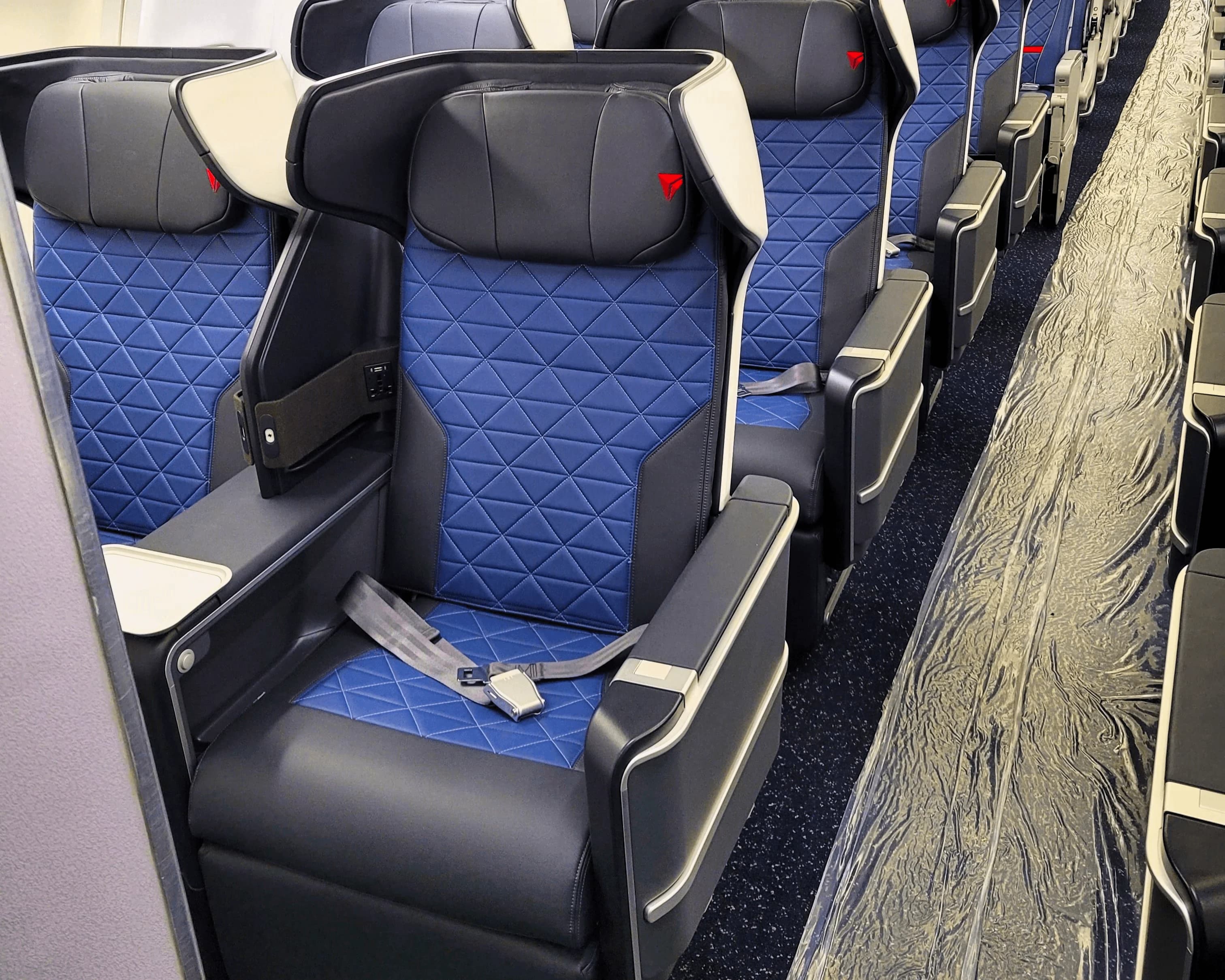
The Boeing 737-800 is Delta's workhorse for domestic and short-haul international flights. This guide reveals which seats offer the best comfort and which ones to avoid on this popular narrow-body aircraft.
TL;DR
Delta's 737-800 features a 2-2 Business Class with 38-39" pitch and a 3-3 Economy layout. Seats 2A, 2D, 3A, and 3D in Business Class offer superior comfort away from the bulkhead galley noise. Avoid rows 1 and 4 entirely due to galley proximity, limited recline, and service disruptions.
Business Class
Delta's Business Class on the 737-800 features a 2-2 configuration with 16 seats total. Seat pitch of 38-39 inches and width of 20.9 inches provides comfortable accommodation for premium passengers. The cabin lacks privacy doors, so aisle seats may experience more frequent service interruptions. Rows 2 and 3 are optimal for avoiding galley activity and lavatory queues.
Premium Economy & Economy Class
Premium Economy is available on select flights with enhanced pitch and width compared to standard Economy. Standard Economy maintains the traditional 3-3 layout with 31-32 inch pitch and 17.3 inch seat width. Middle seats are cramped on this narrow-body aircraft, making window and aisle seats preferable.
Best Seats
Seat
Cabin
Why
2A
Business
Window seat away from galley, excellent legroom and pitch
2D
Business
Aisle seat with direct galley access but less foot traffic
3A
Business
Window seat in prime location, quieter than Row 1
3D
Business
Aisle seat with optimal service flow and comfort
Seats to Avoid
Seat
Cabin
Why
1A, 1B, 1C, 1D
Business
Bulkhead row with galley noise, limited recline, constant service disruptions
4A, 4B, 4C, 4D
Business
Last Business Class row before Economy, lavatory proximity causes congestion
⚡ Power & Connectivity Reality Check
Delta's 737-800 lacks seatback AC power outlets in Business Class; USB ports are available at most seats but inconsistently positioned on older aircraft - check your specific armrest before unpacking cables. WiFi is handled through Delta's standard seatback IFE system (not streaming-to-device like newer fleets), with Bluetooth audio support for wireless headphones on most refurbished cabins. Real-world speeds are adequate for email and light browsing on domestic routes, but expect degraded performance during peak cabin usage; international hops perform marginally better due to lower passenger density. The airline has been gradually retrofitting older 737-800s, so power availability can vary significantly by aircraft tail number.
🧳 Overhead Bin Strategy
The 737-800's overhead bins offer approximately 5,500 cubic inches of total capacity, which accommodates most carry-ons but fills quickly on full flights - Business Class passengers gain priority access, though Rows 2 - 3 often sacrifice bin space to galley and equipment storage. Gate-checking becomes likely on flights with 150+ passengers, particularly if you're not boarded in the first two groups; arriving at the gate early or traveling with elite status helps secure bin access. Standard roller bags fit wheels-in on the 737-800, but narrower sideways placement is safer on crowded flights. Rows 4 - 8 (upper deck forward) board early enough to guarantee overhead space, while Rows 9+ risk losing bin access entirely on domestic full flights.
🏃 Boarding & Exit Strategy
Delta uses a five-tier boarding system (First/Comfort+, Main Cabin Extra, Medallion elites, zones 1 - 2, zones 3 - 5), with Business Class passengers boarding in the first group via the forward door. Seats 1 - 4 (window and aisle pairs in Business) deplane fastest through the forward galley exit, followed by Rows 5 - 8; the 737-800 typically uses only the front door for deplaning on domestic routes, making rear seats significantly slower. For tight domestic connections under 45 minutes, Book Seat 1A or 1B to exit first and maximize layover buffer time. The rear lavatory and galley (Rows 9 - 10 area) experience the longest deplaning delays, adding 3 - 5 minutes compared to forward cabin passengers on standard 150-passenger flights.
📱 The Booking Intelligence
Seat selection for Main Cabin passengers opens at check-in (24 hours before departure); Business Class and Medallion elites unlock preferred seats 75+ days in advance, giving them first pick of premium economy bulkhead and exit-row positions. Exit rows are held back for elite members and revenue-paid upgrades until 72 hours before departure, after which they release to standard frequent flyers and paid seat selection. Premium overhead-bin-guaranteed seats (Rows 2 - 8) typically become available 10 - 14 days out, though Business Class locks these immediately. Practical tip: Set a calendar alert for exactly 72 hours before departure and refresh Delta's seat map at 11:01 p.m. ET (just after system updates) - exit rows and bulkhead seats with extra legroom frequently drop at this window due to cancellations and elite rebooking.
FAQ
Does the 737-800 have privacy doors in Business Class?
No, Delta's 737-800 Business Class lacks privacy doors. While the 2-2 layout provides more space than Economy, you should expect moderate cabin activity.
What's the difference between window and aisle seats in Business?
Window seats offer privacy and a place to rest your head, while aisle seats provide easier access to lavatories and galleys. Both configurations have trade-offs on this aircraft.
Is Premium Economy worth the upgrade?
Yes, if available on your flight. Premium Economy offers noticeably more pitch and width than standard Economy, making it a solid middle-ground option.
Why should I avoid Row 1 in Business Class?
Row 1 is positioned directly in front of the galley, causing constant noise from beverage service, ice makers, and crew movement throughout the flight.
Are middle seats in Economy usable?
Middle seats in the 3-3 Economy configuration are tight on the 737-800's narrow fuselage. They lack direct aisle or window access, making them the least desirable option.