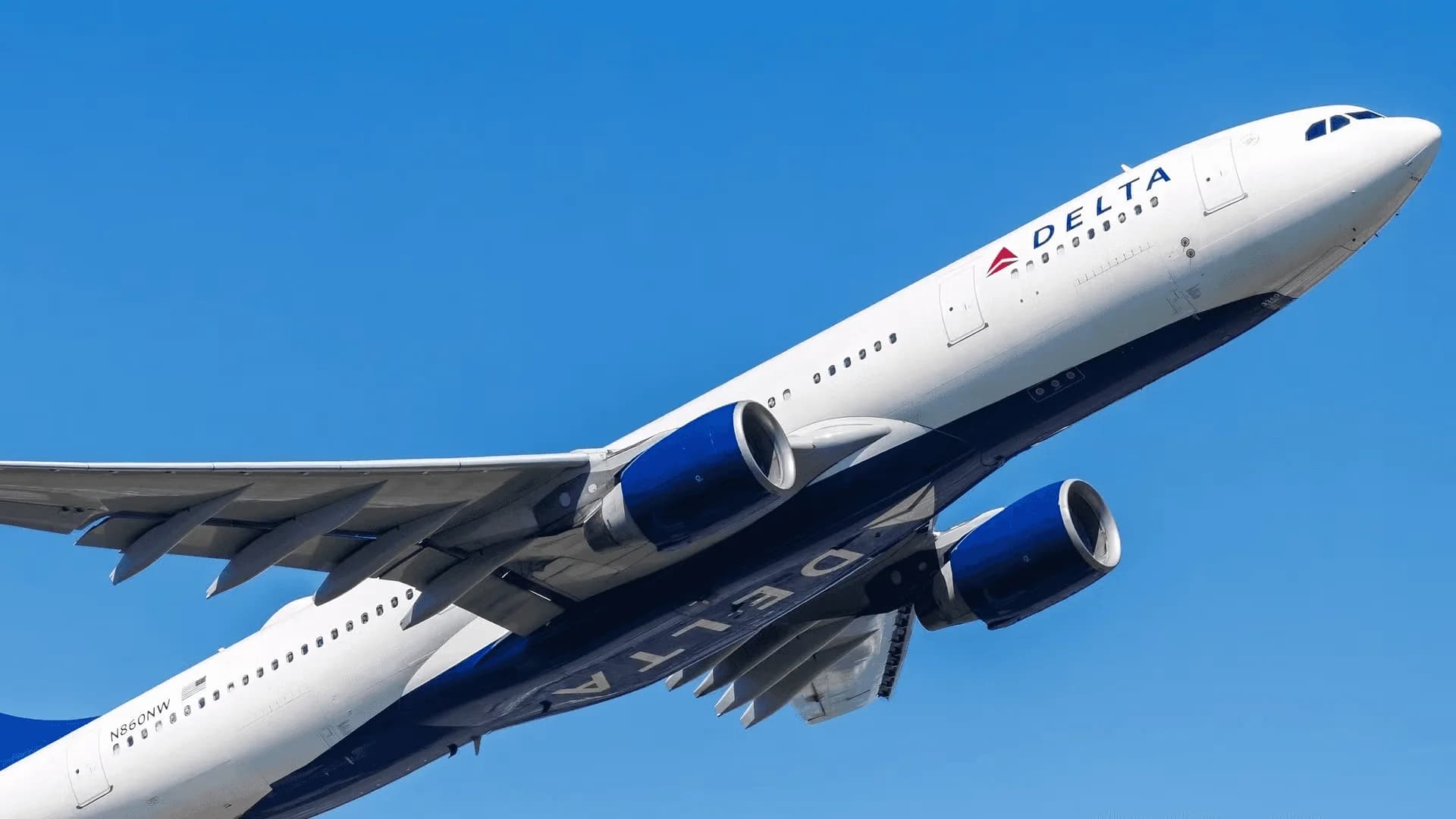
Delta's Airbus A330 is a popular long-haul aircraft featuring Delta One business class, Premium Select, and Main Cabin Economy. Understanding the seat layout and configuration will help you maximize comfort on your next transatlantic or international flight.
TL;DR
The A330 features a 1-2-1 business layout, 2-4-2 Premium Select, and 3-3-3 economy configuration. Best seats are Delta One's direct-aisle options (4A, 5A, 6A, 4K, 5K, 6K) and Premium Select rows 20-21 for families. Avoid center middle seats E/F in economy, the bulkhead row 30, and rows near lavatories due to noise and limited amenities.
Business Class (Delta One)
Delta One on the A330 offers approximately 40 seats in a 1-2-1 configuration, providing direct-aisle access for all passengers. The cabin features fully flat-bed seats with direct-aisle positioning on both sides, ensuring privacy and comfort. Solo travelers benefit from window or aisle seats, while couples can select center pairs. The cabin does not feature privacy doors between seats.
Premium Select
Premium Select offers enhanced comfort with extra legroom and premium amenities positioned between business and economy. Rows 20-21 are particularly ideal for families, offering good cabin positioning with proximity to lavatories and galleys without the noise of rear economy.
Economy Class (Main Cabin)
Main Cabin features a 3-3-3 configuration with 32-inch pitch, standard for wide-body aircraft. The cabin spans multiple rows with consistent seating throughout. Avoid center middle seats E/F which lack both window and aisle access, and be cautious of rows positioned near lavatories or galleys.
Best seats
Seat
Cabin
Why
4A, 5A, 6A
Delta One
Direct aisle access with window; preferred for solo travelers
4K, 5K, 6K
Delta One
Direct aisle access with window on alternate side; ideal for solo travelers
4D/4G, 5D/5G, 6D/6G
Delta One
Center pairs ideal for couples with direct aisle access on both sides
20A-20J, 21A-21J
Premium Select
Optimal positioning for families; good cabin location away from noise
Window or Aisle seats
Main Cabin
Rows with A, C (windows) or D, J (aisles) provide comfort and access
Seats to avoid
Seat
Cabin
Why
30D, 30E, 30F, 30G
Main Cabin
Bulkhead row with no floor storage space for carry-on luggage
Last 2-3 rows
Main Cabin
Limited recline, proximity to galleys and lavatories, increased foot traffic
Rows in front of lavatories
Main Cabin
Noise, odors, and standing passengers waiting for facilities
E, F middle seats
Main Cabin
No window or aisle access; least desirable in 3-3-3 configuration
💻 Digital Nomad Workspace Audit
The A330's tray table is moderately stable for a 15-inch laptop in both Business and Economy, though Business Class offers superior ergonomics with larger, hydraulically-damped tables; Economy tray tables have slight wobble on turbulence but are adequate for light work. Delta's Viasat satellite WiFi (branded "Delta Wi-Fi") delivers 5 - 15 Mbps on the A330 depending on aircraft saturation and ground coverage, sufficient for email and messaging but unreliable for video conferencing. Power availability varies significantly: Business Class seats feature 110V AC outlets and USB-A ports (2.4A per port); Economy has scattered USB-A outlets in armrests and seatback pockets with minimal wattage (typically 500mA), making a portable battery essential for full-day work. The IFE screen measures 10.6 inches in Business and 9 inches in Economy, with responsive touchscreens; Bluetooth audio pairing works reliably to personal headphones via the IFE menu, though legacy aircraft may not support all modern codecs.
🔊 Acoustic & Sensory Audit
The A330-200/300 maintains a cabin altitude of approximately 8,000 feet, characteristic of older widebody designs and noticeably higher than newer 787/A350 aircraft, resulting in faster fatigue and drier conditions on ultra-long-haul flights. Humidity levels average 10 - 15% throughout the flight, among the lowest in commercial aviation, making moisturizer and hydration non-negotiable for overnight routes. Engine noise concentrates in rows 30 - 45 (mid-to-rear Economy) with a steady turbofan rumble at cruise; forward cabin noise peaks near the galley area due to service activity and hydraulic systems. The quietest specific seats are rows 10 - 14 on the A330, positioned forward of the main landing gear and away from both engine noise and rear galley disturbance, making them ideal for sleep on overnight services despite their Economy classification.
🚪 Deplaning Intelligence
Delta uses door L1 (forward main deck) as the primary exit for all cabin classes on the A330, with L2 (aft main deck) as secondary on full flights; Business deplanes first via L1 in approximately 8 - 12 minutes, while full Economy completion typically requires 22 - 28 minutes from the moment the cabin door opens. Front-of-cabin Economy (rows 20 - 25) will deplane within 10 - 14 minutes of the first passenger exiting, while rear Economy (rows 45 - 54) may wait 18 - 25 minutes in the aisle before reaching the ground. At Delta's primary A330 hubs (Atlanta ATL, Detroit DTW, and Minneapolis MSP), a minimum 90-minute connection time is comfortable for domestic onward flights and 120 minutes for international connections, accounting for potential gate distances and TSA PreCheck variability.
🌙 The Overnight Formula
Book seat 12A or 12J (Business Class window seats in the quieter forward section) for overnight transatlantic flights; if Budget-constrained, rows 11 - 14 in Economy window seats (A, F, or J) offer the best sleep environment due to minimal foot traffic and distance from galley noise. Skip the dinner service on westbound overnight flights (departing evening, arriving morning) to maximize uninterrupted sleep; eat the meal on eastbound red-eyes (departing evening, arriving next evening) when circadian adjustment requires the anchor point. Bring a contoured neck pillow rated for side-sleepers and a lightweight cashmere eye mask with ear-flap coverage - the A330's dry cabin and engine noise make these two accessories non-negotiable. Optimize arrival by setting your watch to destination time immediately after takeoff, requesting a window seat to control light exposure, avoiding alcohol (dehydrates further at 8,000 feet), and timing your sleep window to land within one hour of your destination's 6 - 8 AM wake time.
FAQ
What is the seat pitch in Delta One business class?
Delta does not publicly specify the exact pitch for Delta One on the A330, but the 1-2-1 configuration with fully flat beds provides exceptional comfort with direct-aisle access for all passengers.
Does the A330 have privacy doors in business class?
No, the Delta One cabin on the A330-200/300 does not feature privacy doors between seats. However, the 1-2-1 layout still provides excellent privacy and personal space.
What is the best row for families in Premium Select?
Rows 20-21 are ideal for families, offering good cabin positioning with convenient access to lavatories and galleys while minimizing exposure to rear economy noise.
Is there a Premium Economy cabin?
Yes, Delta offers Premium Select on the A330, providing enhanced legroom and amenities between business and main cabin economy.
Why should I avoid the middle seats in economy?
The center E and F seats in the 3-3-3 configuration lack both window and aisle access, offering no storage options or direct passage, making them the least comfortable economy options.