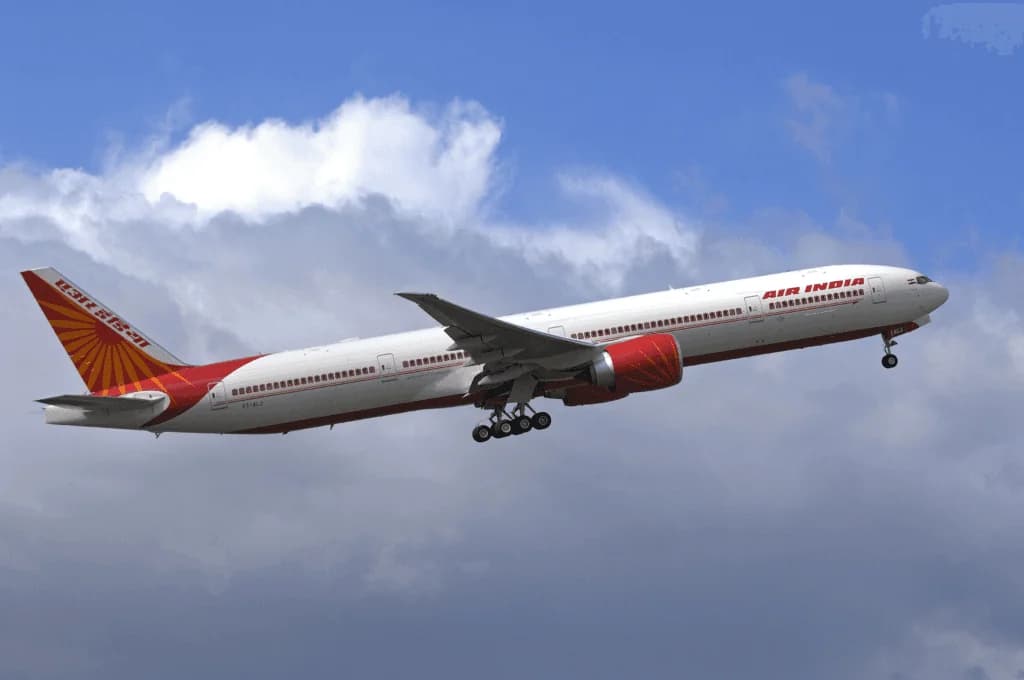
Air India's Boeing 777-300ER offers premium Business Class suites on newer aircraft alongside spacious Premium Economy and Economy options. The fleet features both modern 1-2-1 suite configurations and legacy angled-flat seating, making seat selection critical for your experience.
TL;DR
Business Class spans rows 1-11 with modern 1-2-1 suites or older 2-3-2 angled-flat beds depending on your aircraft. Mid-cabin window suites (rows 4-8) offer optimal privacy and aisle access. Premium Economy bulkhead seats provide extra legroom, while Economy passengers should target exit rows. Avoid row 1 Business due to bulkhead restrictions.
Business Class
Air India's Boeing 777-300ER Business Class occupies rows 1-11 with two distinct product types depending on aircraft configuration. Newer aircraft feature premium 1-2-1 suite layouts with direct aisle access and privacy doors on all seats, representing a significant upgrade. Older aircraft utilize a 2-3-2 angled-flat bed configuration. Suite equipped aircraft provide superior comfort with enclosed privacy, individual storage, and better isolation from adjacent passengers. All Business Class passengers enjoy premium amenities, priority boarding, and dedicated cabin crew service.
Premium Economy Class
Air India's Premium Economy cabin bridges the gap between Business and Economy with enhanced comfort and service. Bulkhead row positioning provides exceptional legroom without seat recline obstruction from forward passengers. Premium Economy passengers receive priority boarding, improved meal service, and dedicated amenities compared to Economy Class.
Economy Class
Economy Class features either a 3-3-3 layout on newer aircraft or 3-4-3 on older configurations. Newer aircraft offer wider seat widths and improved cabin ambiance. Economy spans the rear cabin with standard legroom and recline functionality. Exit row seats provide additional legroom for taller passengers willing to accept operational responsibilities during flight.
Best seats
Seat
Cabin
Why
4A, 4K, 5A, 5K, 6A, 6K, 7A, 7K, 8A, 8K
Business
Mid-cabin window suites on newer 1-2-1 equipped aircraft offer ideal balance of privacy, aisle access, and cabin positioning away from lavatories and galleys
20A, 20K
Premium Economy
Bulkhead row seats provide maximum legroom without forward recline interference, ideal for long-haul comfort
Exit rows (exact rows vary)
Economy
Exit row seats offer significantly increased legroom for enhanced comfort on long flights
Seats to avoid
Seat
Cabin
Why
Row 1
Business
Bulkhead location limits recline functionality and overhead space; proximity to flight deck creates operational noise
Rows near galleys and lavatories
All classes
Increased crew activity, noise, and odor disruption throughout flight
Aft-most Economy rows
Economy
Reduced recline, proximity to lavatories, and engine noise impact comfort on long-haul flights
💻 Digital Nomad Workspace Audit
Air India's 777-300ER Business Class suites feature exceptionally stable tray tables suitable for 15-inch laptops, with the direct-aisle configuration eliminating neighbor disturbance during work sessions. WiFi is delivered via Intelsat or Viasat depending on aircraft age, typically offering 5-15 Mbps download speeds sufficient for email and light browsing but inadequate for video conferencing. Power availability varies: newer suite aircraft provide both AC outlets (110V) at each seat and USB-A ports (2.1A), while older 2-3-2 configurations offer USB-A only; no USB-C is standard across the fleet. IFE screens measure 16-17 inches on newer aircraft versus 15.4 inches on older models, and Bluetooth audio pairing is available on post-2018 retrofitted aircraft only, making wired headphone adapters essential for legacy configurations.
🔊 Acoustic & Sensory Audit
The 777-300ER pressurizes to a cabin altitude of approximately 7,500 feet - higher than modern widebodies but lower than older 747s - resulting in moderate humidity levels around 12-15% and measurable fatigue on flights exceeding 12 hours. Engine noise is most pronounced in rows 8-11 of Business Class where fuselage proximity to the rear engines amplifies low-frequency rumble; rows 1-4 experience lighter Rolls-Royce RB211 harmonics with noticeable reduction near the galley transition at row 6. Quietest seats are 1A, 1K, 2A, and 2K in the suite-equipped aircraft, as forward position and door closure provide active noise isolation; in angled-flat configurations, aisle seats (2B, 2E, 3B, 3E) offer marginally better acoustics due to structural dampening along the cabin wall.
🚪 Deplaning Intelligence
Air India's 777-300ER operates with forward doors L1 (main deck) and L2 (lower deck on freight-equipped variants, though rarely used for passengers), with Business Class passengers deplaning exclusively through L1 via dedicated jetway priority in most hub configurations. On full flights, Business Class completes deplaning within 6-8 minutes due to small cabin size (only 52 seats) and forward cabin positioning; Economy deplanes in sequential waves requiring 18-22 minutes total. For same-day connections at Delhi (DEL) or Mumbai (BOM), Air India recommends minimum 90 minutes in domestic transfers and 120 minutes for international onward flights, though Business Class fast-track immigration and lounge access can reduce this to 75 minutes practically.
🌙 The Overnight Formula
For Delhi-bound overnight flights, reserve seats 1A or 1K in suite-equipped aircraft for maximum darkness and privacy, or 2A/2K in angled-flat configurations for front-row priority boarding and early meal service completion. On red-eye routes, accept the first meal service offered (typically within 45 minutes of departure) to establish circadian alignment with destination morning, then request cabin crew disable overhead lighting and close your suite door immediately post-service to enable 6-8 hour sleep windows. Bring a memory foam neck pillow rated for side-sleeping, a 100% silk eye mask (cabin doors don't fully blacken), and compression socks to mitigate the 7,500-foot altitude effect; take melatonin 30 minutes before intended sleep onset rather than relying on alcohol. Request cabin crew wake you 90 minutes before arrival for shower access (available on 14+ hour flights) and light breakfast, ensuring arrival at Delhi or Mumbai with 4+ hours of wakefulness before onward connections or ground transport.
FAQ
What's the difference between Air India's Business Class configurations?
Newer Boeing 777-300ER aircraft feature premium 1-2-1 direct-aisle suites with privacy doors, while older aircraft operate 2-3-2 angled-flat beds. Check your specific aircraft during booking - suites offer significantly superior privacy and comfort for long-haul travel.
Which airline seat websites have Air India 777-300ER seat maps?
SeatGuru, Seat Guru, and airline-specific seat maps on Air India's website provide detailed configurations. Always verify the specific aircraft registration before booking, as Air India operates both legacy and new 777-300ER variants.
Are privacy doors standard on all Air India Business suites?
Privacy doors are standard on newer 1-2-1 suite equipped aircraft. Older 2-3-2 angled-flat Business Class does not feature privacy doors. Confirm your aircraft type before booking for premium privacy features.
What's the best Economy seat on Air India's 777-300ER?
Exit row seats offer maximum legroom for Economy passengers. Forward mini-cabin window seats also provide good positioning. Avoid aft rows near lavatories and galleys for optimal comfort on long-haul flights.
Is Premium Economy worth it on this aircraft?
Premium Economy provides meaningful upgrades including extra legroom, dedicated service, and superior meal options. For long-haul routes, the bulkhead positioning and comfort improvements justify the premium for many travelers.