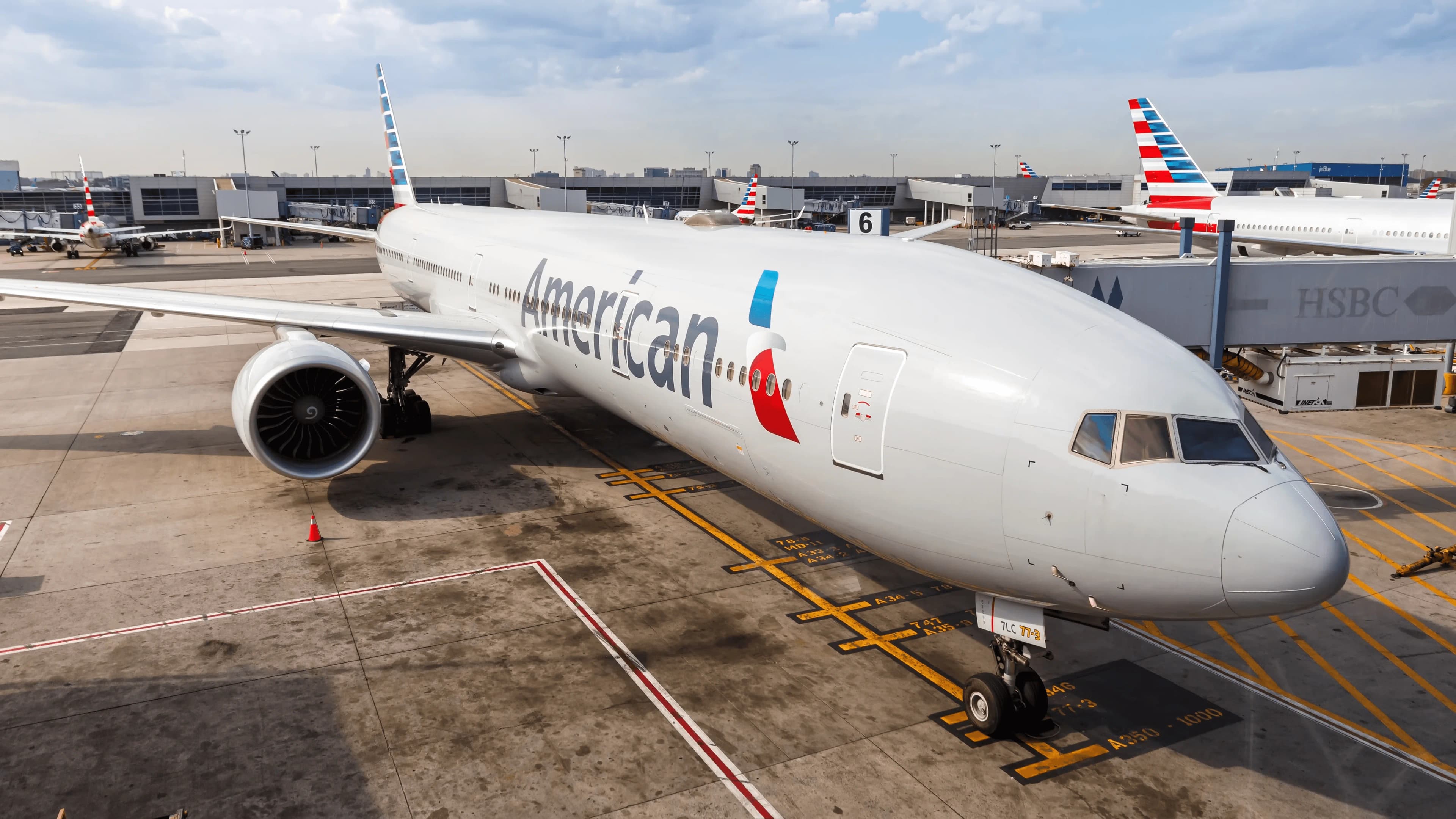
The Boeing 777-300ER is American Airlines' flagship widebody aircraft, featuring a sophisticated 1-2-1 Business Class configuration and spacious Economy seating. This guide helps you navigate the different cabin layouts and select the best seats for your transatlantic journey.
TL;DR
Business Class features a 1-2-1 Super Diamond layout with direct aisle access in all seats. Premium Economy offers enhanced comfort between Business and Economy. Economy uses a standard 3-4-3 configuration. Book seats 2A or 2J in Business for optimal positioning, and avoid seats near lavatories and galleys in Economy.
Business Class
American Airlines' Business Class on the 777-300ER features the coveted 1-2-1 Super Diamond configuration, with either 52 seats (Flagship) or 70 seats (Project Olympus) depending on the specific aircraft. The 1-2-1 layout means every seat has direct aisle access, eliminating the middle seat squeeze. Seats are arranged in a staggered diamond pattern that maximizes privacy and personal space. The cabin includes premium bedding, direct aisle access, and modern in-flight entertainment systems.
Premium Economy
Premium Economy provides a comfortable mid-cabin option with enhanced legroom and amenities compared to standard Economy. Passengers enjoy priority boarding, improved meal service, and extra recline compared to Economy Class.
Economy Class
The Economy cabin uses a standard 3-4-3 configuration across the Boeing 777-300ER's wider fuselage. This layout provides more elbow room than narrow-body aircraft. Standard seat pitch and width apply, with overhead bin space available above most seats. Exit row seats offer additional legroom but may have restricted recline. Avoid seats near the rear lavatories and galleys, which experience higher traffic and noise levels.
Best seats
Seat
Cabin
Why
2A
Business
Window seat in Super Diamond with direct aisle access and optimal privacy
2J
Business
Window seat on opposite side with same privacy and aisle access benefits
10A/10J
Business
Mid-cabin positions offer good balance of galley distance and cabin atmosphere
1A
Premium Economy
Forward position with priority boarding benefits and quiet cabin location
11A/11F/11J
Economy
Forward Economy with better amenity access and smoother ride
Seats to avoid
Seat
Cabin
Why
Rows 60-65
Economy
Located near rear lavatories and galleys; expect noise and odors from bathroom traffic
Row 77+
Economy
Tail section experiences significant vibration and noise during flight operations
Middle seats (all rows)
Economy
Standard middle seat disadvantages; less personal space and shared armrests
Seats near emergency exits
Economy
May have restricted recline or blocked window views due to safety regulations
💻 Digital Nomad Workspace Audit
Business Class seats feature robust tray tables that accommodate 15-inch laptops comfortably when fully extended, with solid supports preventing wobble during typing. American Airlines offers Viasat WiFi with speeds reaching 15 - 25 Mbps on 777-300ERs equipped with the newer system; power options include dual USB-A ports (2.1A each) and one USB-C port (18W) at each seat, plus a 110V AC outlet in select Business seats on Flagship aircraft. The 10.6-inch seatback IFE screens support Bluetooth audio pairing for personal headphones, though wired 3.5mm jacks remain the most stable option for video calls. Seats 1A, 2A, 2C, 3A, and 3C in the forward cabin offer the quietest acoustic environment with minimal galley interference, making them optimal for focused work on transoceanic routes.
🔊 Acoustic & Sensory Audit
The Boeing 777-300ER maintains a cabin altitude of approximately 7,500 feet during cruise, sitting between older widebody aircraft (8,000 - 8,100 ft) and modern competitors like the 787 (6,000 ft), with pressurization and humidity controls yielding 40 - 50% cabin humidity on intercontinental flights. Engine noise is most pronounced in rows 12 - 18 of Economy (directly aft of engines) and diminishes significantly forward of row 8 and aft of row 50. Business Class rows 1 - 3 benefit from the reinforced flight deck structure forward, while mid-cabin Business seats (rows 4 - 7) experience the smoothest airflow and lowest turbulence proximity, making rows 5A and 5C the acoustically optimal choices for sleep or focused work. Engine whine frequencies are absorbed more effectively in center seats due to fuselage mass, though the 1-2-1 diamond layout places all Business seats in superior quiet zones compared to Economy.
🚪 Deplaning Intelligence
On 777-300ERs, Business Class deplanes via door L1 (forward) while Economy exits through doors L2 (mid-cabin) and R2/R3 (aft), meaning Business passengers typically clear the aircraft within 3 - 5 minutes on full flights, a 15 - 20 minute advantage over rear Economy. On American Airlines' primary hubs (DFW, CLT, ORD, MIA), Business passengers connecting through premium lanes clear immigration and security in 12 - 18 minutes from touchdown, making 90 minutes the comfortable minimum for domestic connections and 120 minutes for international onward flights. Seats in rows 1 - 2 deplane first and reach the gate agents roughly 2 minutes ahead of rows 3 - 4, a minor advantage that compounds in tight connection windows during ground congestion.
🌙 The Overnight Formula
Book seat 1A, 1C, 3A, or 3C for overnight transatlantic or transpacific flights - these forward Business seats experience the least cabin movement, vibration, and service disruption, with the flight deck structure dampening pressure-related discomfort. Accept the dinner service on departure (timing sleep 3.5 - 4 hours post-departure) but politely decline breakfast service 90 minutes before arrival, allowing uninterrupted sleep through the final circadian transition window; inform the crew "do not disturb" after lights-dim. Bring a noise-isolating pillow (memory foam that conforms to the recline pod), a 100% silk sleep mask (reduced static and eye irritation), and compression socks to mitigate deep vein thrombosis risk on flights over 7 hours. Land refreshed by sleeping in the 1 - 6 AM window (UTC+0 reference), avoiding the final approach turbulence; request the cabin crew wake you 45 minutes before descent with water and a cool towel, not hot breakfast, to prime circadian resynchronization at your destination timezone.
FAQ
Does every Business Class seat have aisle access on the 777-300ER?
Yes. The 1-2-1 Super Diamond configuration ensures all Business Class passengers have direct aisle access. This eliminates the need to climb over a neighbor to get to the aisle.
What's the difference between Flagship and Project Olympus configurations?
Flagship features 52 Business Class seats while Project Olympus has 70 Business seats. Project Olympus aircraft offer more Business capacity but maintain the same 1-2-1 layout with full aisle access for all passengers.
Is Premium Economy worth booking on this aircraft?
Premium Economy offers a good middle ground with enhanced legroom, better meals, and priority services. It's ideal if Business is out of budget but you want more comfort than standard Economy.
Where should I avoid sitting in Economy?
Avoid the last 5-10 rows near the rear lavatories and galley, where noise and odors are most noticeable. Also avoid middle seats for obvious reasons, and seats with restricted recline near emergency exits.
What's the best Business seat for couples?
Consider pairing seats like 1A/1B or 2A/2B to sit adjacent while maintaining the privacy benefits of the 1-2-1 layout. Window and middle positions offer direct aisle access for both passengers.
How is the Economy legroom on the 777-300ER?
Standard Economy pitch is typical for long-haul aircraft. Exit row seats offer significantly more legroom but may have limitations on recline or window obstruction. Premium Economy provides the best Economy-cabin legroom option.