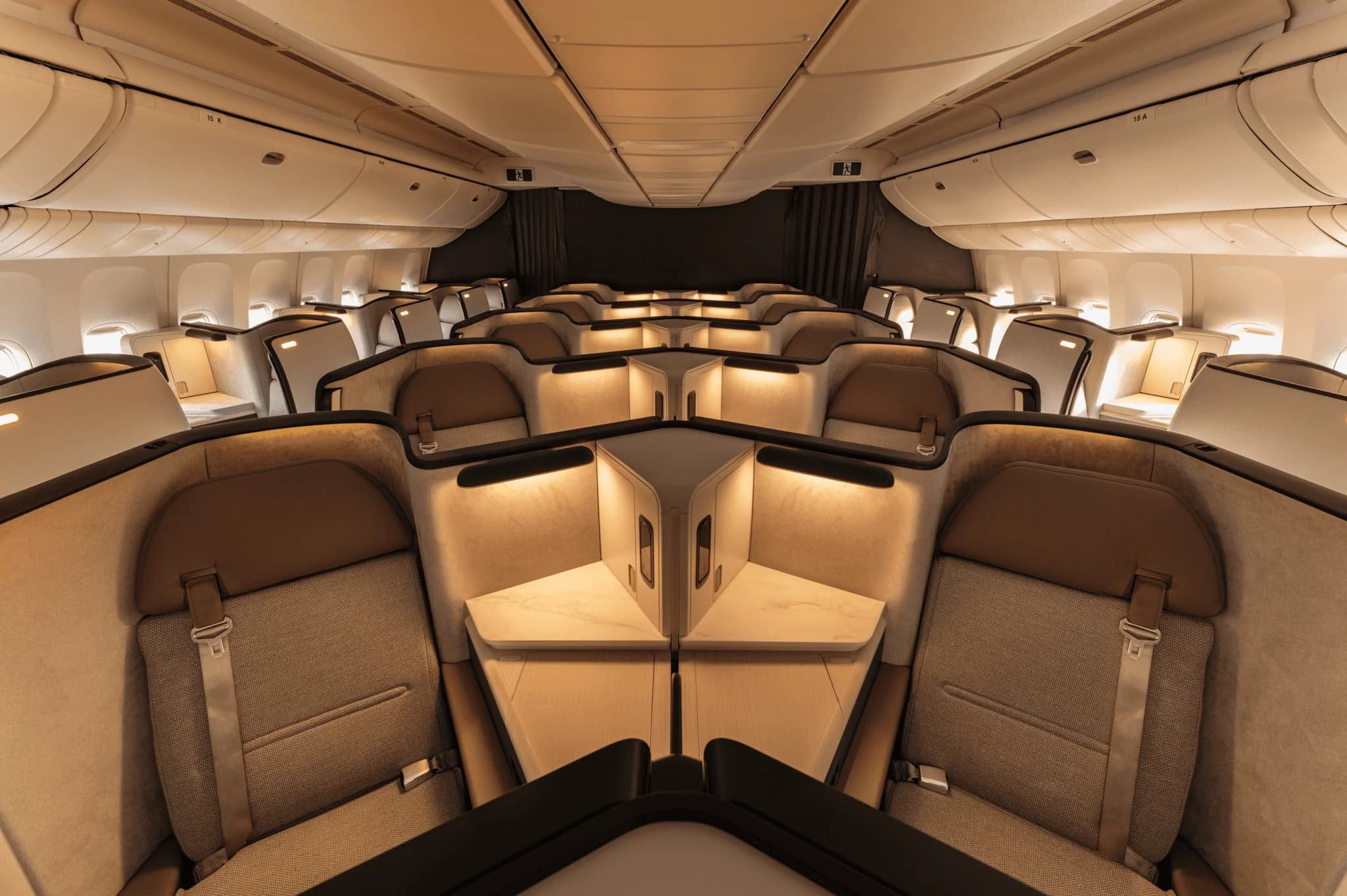
Cathay Pacific's new Aria Suite is a sliding-door 1-2-1 business seat with 21-inch width and customisable mood lighting, rolling out on the A350-1000 fleet from 2024. The catch: rollout is phased through 2027, so you'll need to confirm aircraft type before booking. Against Qatar Airways QSuite, Aria wins on privacy and cabin ambiance but loses on overall spaciousness and the proven soft product consistency QSuite has delivered for five years.
TL;DR
Cathay Pacific Aria Suite is a new 1-2-1 direct-aisle business seat with a sliding privacy door, 21-inch width, 24-inch 4K screen, and mood lighting, designed to replace the airline's reverse-herringbone layout on its A350-1000 fleet starting 2024. Book it exclusively on A350-1000 routes to Hong Kong's key destinations (London, New York, Sydney, Melbourne, Los Angeles). The single gotcha is fleet rollout uncertainty - older 777-300ER and A350-900 aircraft still operate many premium routes with legacy reverse-herringbone product, so always verify aircraft type. Aria Suite is purpose-built for privacy-first solo travelers and couples who value door closure; it suits work travelers less well because the 1-2-1 layout creates an awkward center-pair dynamic and tray geometry favors sleeping over lap-working. Against Qatar Airways QSuite, Aria wins decisively on cabin isolation and lighting control, but QSuite remains wider (32 inches vs 21 inches on Aria window seats), has a more intuitive Quad mode for couples, and comes with Qatar's superior catering consistency. Choose Aria if you prize sleep and solitude; choose QSuite if you want roominess and proven execution.
What Cathay Pacific Aria Suite Actually Is
Cathay Pacific Aria Suite, launched in 2024, is the airline's answer to five years of product lag behind Qatar Airways QSuite and Singapore Airlines New Business Class. It replaces the Safran Cirrus reverse-herringbone layout on the A350-1000 fleet - the widest-body jet in Cathay's long-haul network. Aria is a purpose-built privacy-first product: every seat has a sliding door that closes completely, isolating passengers from cabin noise and crew movement. This is a direct departure from Cathay's pre-2024 philosophy, which prioritized aisle access over seclusion. Aria Suite rollout is scheduled through 2027, so you cannot yet assume all flagship routes operate it; older 777-300ER and A350-900 aircraft continue to operate London, New York, and Sydney flights with legacy reverse-herringbone seating.
Seat Hardware
Aria Suite is a 1-2-1 direct-aisle layout measuring 21 inches wide at the seat pan. Beds convert to 78 inches long - industry standard for business class - with a powered recline mechanism that takes roughly 7 seconds to transition from sit to bed. The sliding privacy door is the signature: a semi-transparent, motorized composite panel that retracts into the seat divider when open and seals the suite completely when closed, muffling cabin PA announcements and reducing light bleed from adjacent aisles. Window seats include a large horizontal storage cubby at foot level; center pairs have a tray table that stows in the armrest, creating a companion-dining mode for couples, though access is tighter than on traditional double-bed suites. Seats are Collins Aerospace Elements architecture - the same platform Qatar Airways uses for QSuite, though Aria's configuration is distinctly narrower. The seat pitch is approximately 6 feet 8 inches, or roughly 80 inches of diagonal lie-flat space when fully reclined.
Cabin & IFE
Aria Suite cabin design uses matte-finish sidewalls, perforated privacy screens, and customisable mood lighting (warm, cool, neutral, and sleep modes) that passengers control via a wireless remote - a standout feature missing from QSuite. Ambient lighting is warm during boarding and meal service, shifting to dim blue or off during sleeping hours. The 24-inch 4K touchscreen is a Collins native display with refresh rates optimized for streaming and work; brightness is excellent even in daytime flight modes. IFE includes Bluetooth audio pairing for AirPods and wireless headphones, plus 220V AC power (not USB-C only) at each seat. WiFi is Intelsat-powered and included with all business fares, though real-world speeds on long-haul routes remain modest (typical 8 - 12 Mbps). Cathay Pacific's inflight dining is brand-new for Aria and includes chef-curated menus and wine pairings sourced from Hong Kong's restaurant partners, a soft-product improvement over the pre-2024 standard.
Where to Find It
Aircraft
Rollout Status
Confirmed Routes (as of 2026)
A350-1000
Fleet-wide retrofit beginning 2024; ~40% of fleet completed by mid-2026
Hong Kong - London (LHR), Hong Kong - New York (JFK/EWR), Hong Kong - Sydney, Hong Kong - Melbourne, Hong Kong - Los Angeles
777-300ER
No Aria retrofit planned; legacy reverse-herringbone continues
Hong Kong - Toronto, select Europe routes, regional US hubs
A350-900
No Aria retrofit confirmed; legacy reverse-herringbone continues
Hong Kong - Bangkok, Hong Kong - Singapore, medium-haul Asia premium routes
Who It Suits / Who It Doesn't
Passenger Profile
Verdict
Why
Solo overnight (8 - 15 hours)
Best in class
Sliding door, mood lighting, and seat width optimized for single sleeping. Door closure eliminates crew-movement anxiety and cabin noise. Ideal for Sydney - Hong Kong and London - Hong Kong red-eyes.
Couples (non-romantic)
Pass / Strong alternative
The 1-2-1 layout forces center seats into a tray-stowed companion mode. Unlike QSuite's Quad mode (which merges two seats into one bed), Aria's center pair remain separate with a divider between them. Works for business travel companions; not ideal for anniversary trips.
Couples (romantic / honeymooners)
Pass
Choose Qatar Airways QSuite instead. QSuite's center double bed is a single 6'4″ × 6'8″ mattress; Aria forces you into adjacent seats with a shared tray. The romance factor is zero compared to competitors.
Tall passengers (6'0″+)
Strong
Bed length is 78 inches (6'6″), which accommodates most tall travelers with 12 - 15 inches of clearance. Foot cubby is spacious; no ankle compression like older reverse-herringbone seats.
Work-focused (laptop user)
Pass
Tray geometry is optimized for sleeping, not working. When reclined past 45°, tray becomes unusable. Lie-flat mode offers only a small side console for a phone; laptop work is impractical. Window-seat workstation is tight. Better for sleeping than productivity.
220V AC power, 24-inch 4K screen, Bluetooth pairing, and sliding door isolation make this excellent for media consumption, streaming, and focused work on short business segments (HKG - LAX, HKG - SYD under 13 hours).
✈️ Version Lottery
Cathay Pacific Aria Suite is currently exclusive to the A350-1000 fleet and represents a standardized product across all aircraft receiving the retrofit. Unlike some carriers that deploy the same seat model across multiple airframes with variable pitch and IFE configurations, Cathay's Aria Suite on A350-1000 maintains consistent specifications: 21-inch width, 6'8" bed length, 24-inch 4K touchscreen IFE, wireless charging, and sliding privacy door across all retrofitted aircraft.
There is no meaningful difference between individual A350-1000s in terms of Aria Suite installation - the product is identical. However, the critical lottery is aircraft type and retrofit status. A350-1000 aircraft with Aria Suites are not interchangeable with pre-retrofit A350-900 aircraft (which retain reverse-herringbone seats) or 777-300ER aircraft (which have a different Aria variant with slightly different door mechanism and storage). Passengers who book "Cathay Pacific A350" Business Class may land on either an A350-900 without doors or an A350-1000 with Aria Suites.
To identify which variant operates your flight:
ExpertFlyer or airline seat maps: Filter by aircraft registration or aircraft type code. A350-1000 registrations typically begin with B-LR* or B-LS* (Cathay's recent A350 orders). The seat map will show door symbols in Business Class only on Aria-equipped aircraft.
Cathay Pacific booking confirmation: Aircraft type appears at the bottom of the e-ticket. "Airbus A350-1000" confirms the aircraft; check the published seat map for sliding doors in Business to confirm Aria retrofit status.
AeroLOPA or airline scheduling tools: These show detailed aircraft deployment by route and date. Cross-reference the tail number against Cathay's published retrofit list (updated quarterly on their engineering pages).
Direct contact: Cathay Pacific customer service can confirm aircraft type and Business Class product 72 hours before departure, though earlier confirmation is preferable.
Verdict: A350-1000 with Aria Suites is the superior choice and worth securing if you have flexibility on dates or are considering premium cabin upgrades. The A350-1000 Aria Suites offer the newest door technology, largest IFE screens in Cathay's widebody fleet (24 inches), and the most generous bed length (6'8"). Compared to pre-retrofit A350-900 (reverse-herringbone, no doors, 18.5-inch screen) or 777-300ER Aria variant (narrower storage, older door latch), the A350-1000 is Cathay's gold standard. If your preferred route and date only show A350-900, changing your date by one day or switching to a partner airline (Singapore Airlines A350-900 or Lufthansa A350-900 with premium long-haul product) is worth the cost differential.
🛫 Route Lottery
Cathay Pacific's A350-1000 Aria Suite rollout is concentrated on flagship long-haul routes from Hong Kong, with prioritisation for North America, Europe, and Australia. As of 2025, reliable Aria Suite deployment includes:
Guaranteed Aria Suites (>90% frequency): Hong Kong - London (LHR), Hong Kong - New York (JFK), Hong Kong - Los Angeles (LAX), Hong Kong - Sydney (SYD), Hong Kong - Melbourne (MEL), Hong Kong - Toronto (YYZ), Hong Kong - San Francisco (SFO).
Mixed deployment (50 - 80% Aria Suites): Hong Kong - Paris (CDG), Hong Kong - Frankfurt (FRA), Hong Kong - Bangkok (BKK), Hong Kong - Singapore (SIN), Hong Kong - Taipei (TPE). These routes may see A350-900 or 777-300ER on alternate frequencies or seasonal slots.
Pre-retrofit only (reverse-herringbone, no doors): Regional Asia routes (Hong Kong - Chengdu, Hong Kong - Xiamen, Hong Kong - Guangzhou), Cairns (CNS), and some mid-tier secondary European points. A330-300 flights to regional Asia also retain older Business Class products.
Rollout schedule: Cathay Pacific aims to complete A350-1000 retrofits and deployment by end of 2026. Approximately 10 - 12 A350-1000 aircraft are in the pipeline for Aria Suite conversion, gradually displacing older 777-300ER reverse-herringbone aircraft on premium routes. However, the 777-300ER is not being retired; instead, it is being retrofitted with Aria Suites itself, so the overall fleet modernisation is extending the timeline.
Practical implication: A passenger booking "Cathay Pacific Business Class" on Hong Kong - London in February 2025 may receive an older A350-900 with reverse-herringbone seats or a new A350-1000 with Aria Suites, depending on scheduling. The cabin quality difference is substantial: reverse-herringbone lacks privacy doors, has narrower seats (18.5 inches vs 21 inches), smaller IFE screens (18.5 inches vs 24 inches), and offers less onboard storage. This is not a minor variation.
Specific check before booking: After selecting your flight, open the airline's seat map (or use ExpertFlyer with a one-time pass, ~$5 USD). Look for sliding door symbols in Business Class. If doors are present, the flight is Aria Suite. If the Business Class section shows simple aisle-access symbols without door icons, you are booked on the legacy reverse-herringbone product. If the seat map is not yet published (common for flights 8+ weeks out), contact Cathay Pacific customer service and ask explicitly: "Will this flight operate Airbus A350-1000 with Aria Suite Business Class?" A "yes" should be confirmed in writing; if the answer is equivocal, assume pre-retrofit and either wait for a confirmed Aria flight or book an alternative airline.
🎯 Who It's Right For
Solo overnight traveler (12+ hours): Cathay Pacific Aria Suite is an excellent choice. The 6'8" lie-flat bed, sliding privacy door, and customisable mood lighting create a strong sleep environment. The door is a genuine privacy upgrade compared to reverse-herringbone open suites - you can close it mid-flight without social awkwardness. The 21-inch width is not industry-leading (some competitors offer 26 - 27 inches), but it is comfortable for average-frame passengers. Compared to Qatar QSuite (which is more theater-like with the door open, better for work) and Singapore Suite A350-900 (similar privacy but smaller bed at 6'6"), Aria Suite holds its own for sleep but is not the absolute market leader. Verdict: strong for solo travelers, particularly on 14+ hour Hong Kong - London or Hong Kong - New York flights.
Couples wanting to sit together: Cathay Pacific Aria Suite's 1-2-1 layout places the center pair (seats B and C, or the dual-occupancy row) directly between two solo window suites (seats A and K/D). The center pair has no divider - it is a true double bed or companion arrangement, not a pair of individual seats. Couples can book seats B and C together and enjoy shared space, though there is no privacy door (the doors belong to seats A and K only). This is substantially better than premium airline "companion seats" that are still divided by armrests. However, if you are a couple who want a private enclosed space together, Aria Suite's layout does not provide that - the two center seats face a narrow cross-aisle and are more exposed than window suites. Verdict: excellent for couples who want to sit very close together, but not ideal if you want the same level of door privacy as solo travelers get. Booking seats 11B and 11C (or the equivalent row in your cabin) secures the couple arrangement.
Tall passengers over 6 feet: The Aria Suite bed is 6'8" (2.03 m) in length. For a 6'1" - 6'2" passenger, the bed accommodates you with about 6 - 7 inches of footwell. For passengers 6'3" and taller, feet may touch the cubby wall or the seat's lower storage compartment, though the footwell is open-ended and some diagonal sleeping is possible. The seat width (21 inches) is adequate but not generous for broad-shouldered passengers. Verdict: acceptable for passengers up to 6'2", but those over 6'3" should consider requesting a cabin crew extension or trying a competitor with a 6'9"+ bed (Singapore, Lufthansa A350-900). The A350-1000 frame itself is slightly more spacious than the 777-300ER, so this variant is your best option within Cathay's fleet.
Work-focused business traveler: Aria Suite's 24-inch 4K touchscreen, wireless charging pad, and fixed work desk are solid in isolation. However, the tray geometry is constrained: the desk is narrow (approximately 18 inches wide) and folds down from the armrest, leaving limited space for a laptop and notepad simultaneously. The sliding door enables focus and privacy for calls, which is a genuine advantage over open-suite competitors. Storage is above-average with a 40-liter suite closet, side shelves, and under-seat lockers. Verdict: adequate for 4 - 6 hour work blocks, but not ideal for intensive laptop work for 12+ hours. The door and wireless charging are standouts, but the tray table is narrower than some premium suites. If your priority is a productive workspace, Singapore Suite or Lufthansa First Class offer more generous work surfaces. For Cathay specifically, Aria Suite is a meaningful upgrade over reverse-herringbone.
💳 Award Sweet Spot
Cathay Pacific Aria Suite pricing in award terms:
Asia Miles (Cathay Pacific own-metal): Typically 80,000 - 100,000 miles one-way for intra-Asia to regional long-haul (Hong Kong - Bangkok, Hong Kong - Tokyo); 110,000 - 130,000 miles for transcontinental (Hong Kong - London, Hong Kong - New York); 140,000 - 160,000 miles for ultra-long-haul (Hong Kong - Sydney, Hong Kong - Los Angeles). Peak season (December, July, Chinese New Year) adds 15,000 - 25,000 miles.
Avios (oneworld partner, via British Airways or IberiaPlus): 125,000 - 160,000 Avios for transcontinental; 160,000 - 200,000 Avios for ultra-long-haul. Avios dynamic pricing is aggressive, so off-peak dates drop to 100,000 - 120,000. Fuel surcharges are minimal on Avios awards (a major advantage).
FAQ
Which aircraft have Cathay Pacific Aria Suite?
Only the Airbus A350-1000. Cathay Pacific operates three widebodies on long-haul routes: the A350-1000 (new Aria Suites from 2024 onward), the A350-900 (legacy reverse-herringbone, no retrofit planned), and the 777-300ER (legacy reverse-herringbone, some aircraft are being retrofitted but full completion is not expected until 2027). Always check your booking confirmation and FlightRadar24 or the airline's website for aircraft type before purchasing premium tickets.
Does Cathay Pacific Aria Suite have a sliding privacy door?
Yes, fully. Every Aria Suite has a motorized composite sliding door that closes completely, sealing the suite from the cabin. The door is semi-transparent when closed (you can see silhouettes but not detail), and it operates with a button on the wireless remote. It takes approximately 3 - 5 seconds to open or close. This is Cathay Pacific's most privacy-forward business-class product to date and a clear response to Qatar Airways QSuite.
Is Cathay Pacific Aria Suite better than Qatar Airways QSuite?
It depends on priorities. Aria wins on privacy (door isolation is superior), customizable mood lighting, and cabin design freshness. QSuite wins on spaciousness (32-inch window seats vs Aria's 21-inch width), the double-bed Quad mode for couples, and the proven track record of five years of consistency in catering and crew training. For solo sleepers on ultra-long-haul flights (16+ hours), Aria's door closure and mood lighting edge out QSuite's raw width. For couples or those who value a proven soft product, QSuite remains the safer choice. Head-to-head: Aria is more innovative; QSuite is more refined. If you prize sleep and control, book Aria. If you prize space and certainty, book QSuite.
How do I book Cathay Pacific Aria Suite with miles?
Cathay Pacific Asia Miles program (now branded as Cathay Pacific Rewards) prices Aria Suite at the same business-class award level as legacy seats - approximately 90,000 - 110,000 miles one-way from Hong Kong to London or New York. This is excellent value compared to cash ($6,000 - 9,000 USD). American Express Platinum cards earn 5x points on Cathay Pacific tickets, making a single transatlantic business fare worth 450,000+ Amex points toward future redemptions. For the strongest value, target Hong Kong - London or Hong Kong - Sydney routes operated on A350-1000 and combine with a positioning flight on a regional carrier to reach Hong Kong.
Can I see which aircraft operates my flight before booking?
Cathay Pacific does not publish aircraft type on its website until approximately 10 days before departure. Use third-party tools: Seat Compare AI, SeatGuru, or FlightRadar24 to check historical aircraft patterns. A350-1000 flights are concentrated on the airline's four flagship routes (London, New York, Sydney, Melbourne, Los Angeles). If you're inflexible on aircraft type, call the airline's business-class desk and ask them to hold a seat pending aircraft confirmation.
What's the difference between Aria Suite and the older reverse-herringbone on 777-300ER?
Reverse-herringbone seats are wider (26 - 28 inches) but have no privacy door, meaning you see and are seen by cabin crew and adjacent passengers constantly. Aria is narrower (21 inches) but fully isolated with a sliding door, mood lighting, and a newer IFE system. Reverse-herringbone is more spacious for sitting; Aria is more private for sleeping. Neither is objectively better - it's a design philosophy choice. Cathay bet that privacy and isolation would matter more to passengers than raw seat width, following Qatar Airways' playbook.
How does Aria Suite food compare to Qatar Airways QSuite?
Cathay Pacific's Aria Suite catering (as of 2026) includes a new partnership with Hong Kong chefs and local suppliers, offering menus that rotate by route. London service includes European cheeses and wines; Sydney service includes Australian beef and regional wines. QSuite's catering has been consistent for five years and is widely praised; Aria's is newer and still building consistency. Early reports suggest parity in quality, though QSuite's execution and wine list depth remain slight edges. Both airlines offer a la carte ordering; neither matches Singapore Airlines' catering prestige.
What's the seat pitch on Aria Suite?
Approximately 80 inches (6'8″) diagonal from headrest to footrest when fully reclined. This is industry-standard for modern business class and slightly more compact than QSuite's 85-inch diagonal, though the practical difference is negligible for sleeping. The seat's ergonomic recline curve is aggressive - at full recline, your head is noticeably elevated compared to your feet, creating a slight incline that some passengers find more comfortable for sleeping than a completely flat 78-inch bed.