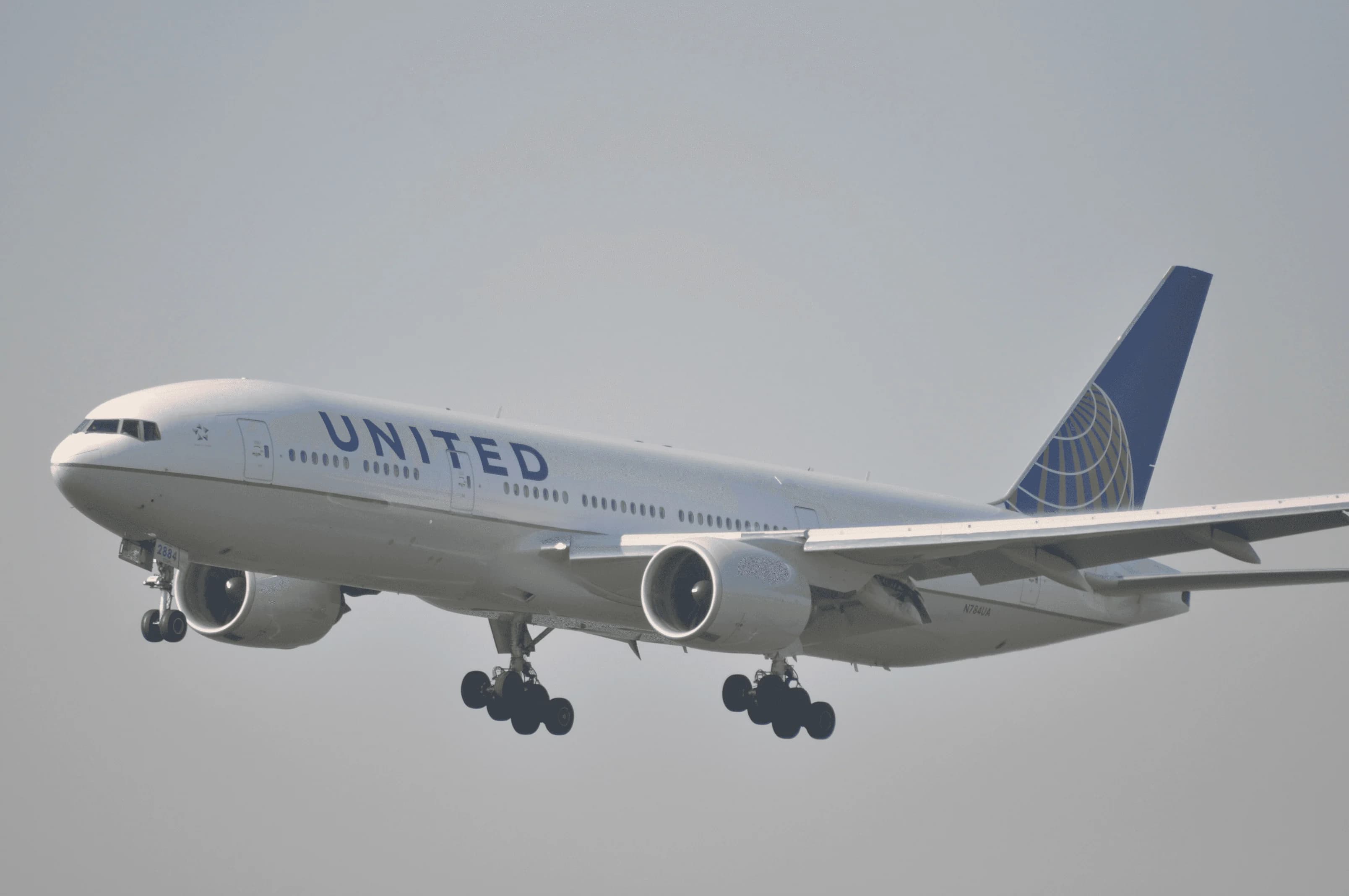
The United Airlines 777-200 is a wide-body workhorse configured with Business, Premium Economy, and Economy cabins across approximately 375 seats. Avoid Economy seats in rows 40 - 48 near the rear galley and lavatories where noise and odor penetrate constantly. This aircraft's defining characteristic is its 3-3-3 Economy layout - wider than competitors - but Business Class lacks the privacy doors found on United's newer 777-300ER.
TL;DR
The United 777-200 is a fleet in transition. The international "v4" configuration is a high-tech masterpiece featuring Polaris and Premium Plus, while the domestic versions are high-density 10-abreast "people movers." Intelligence is critical to ensure you aren't stuck on a domestic-configured plane for a long-haul flight.
The United Airlines Boeing 777-200 is a complex aircraft to track because of its multiple configurations. For the 2026 traveler, the intelligence focuses on the v4 Polaris Retrofit. These aircraft feature the 1-2-1 Polaris pods, a dedicated Premium Plus cabin (2-4-2), and Economy sections that are 3-4-3. If you see a 2-4-2 Business Class layout on your seat map, you are looking at an un-refurbished aircraft, which usually operates high-density domestic or Hawaii routes.
Polaris Intelligence: Staggered Privacy
The Polaris cabin (Rows 1-12 on most variants) uses a staggered 1-2-1 layout. Intelligence reveals that the odd-numbered window seats (1, 3, 5, etc.) are the "True Windows." They are flush against the window with the console protecting you from the aisle. The even-numbered seats are angled toward the aisle and feel significantly more exposed. For those with larger feet, the bulkhead seats (Row 1 and Row 9) have much larger footwells, as they are not restricted by the seat structure in front of them.
Premium Plus & Economy Dynamics
United’s Premium Plus (Rows 20-22) is a standout for value. Intelligence suggests Row 20 is the premier choice, as it offers a full leg rest and massive bulkhead space. In Economy, the 3-4-3 configuration is tight. To maximize comfort, focus on Economy Plus (Rows 30-34). Row 30 is an exit row that provides near-limitless legroom, but be aware that it is located directly behind the galleys, meaning it can be cold and bright during red-eye flights.
Best Seats
Seat
Cabin
Why
1L & 9L
Polaris
Bulkhead suites with extra-wide footwells and maximum privacy.
3A & 5L
Polaris
"True" window seats; furthest from the aisle and very private.
20A & 20L
Premium Plus
Bulkhead seats with leg rests and the most physical space in the cabin.
30A & 30L
Economy Plus
Exit row bulkhead; infinite legroom for tall travelers.
Seats to Avoid
Seat
Cabin
Why
11A & 11L
Polaris
Misaligned window; you have to lean forward to see out.
22D & 22G
Premium Plus
Last row of the cabin; restricted recline and noise from Economy behind.
39A & 39L
Economy
No window; located directly at the wing root.
50A - 50L
Economy
Last row; no recline, close to the engines and rear lavatories.
💻 Digital Nomad Workspace Audit
The United Airlines 777-200 presents a mixed workspace environment. Economy tray tables measure approximately 17 inches wide by 9 inches deep - adequate for a 13-inch laptop in landscape mode but cramped for 15-inch machines, which will overhang into the aisle or require the window seat neighbor to shift. Tray table stability is moderate; turbulence creates noticeable flex, making extended typing sessions uncomfortable.
United's 777-200 fleet operates with Viasat inflight WiFi on most aircraft, though some older variants retain Panasonic GX systems. Real-world speeds on transcontinental routes average 4 - 6 Mbps download in moderate traffic periods; transatlantic flights see 2 - 4 Mbps due to satellite handoff delays. Peak hours (8 - 10 AM, 5 - 7 PM) degrade performance by 30 - 50%. Premium Cabin passengers and 1K elites receive priority bandwidth.
Power outlets by cabin: Business Class seats feature AC 110V sockets (100W) and dual USB-A ports. Premium Economy offers single USB-A outlets (5W) at select rows. Economy seats in rows 25 - 35 have no built-in power; USB-A ports appear sporadically at armrests in rows 36 - 45 with 2.1A output. Carry an external battery rated 20,000 mAh or higher for any Economy transatlantic flight.
The IFE system uses a 9-inch seat-back screen on Economy seats; responsiveness lags when multiple systems sync during meal service, causing 2 - 3 second delays between input and menu response. Bluetooth audio pairing is not available on 777-200 Economy systems. Business Class offers newer 16-inch HD screens with responsive touchpanels and full Bluetooth capability.
Verdict: The 777-200 is suitable for light email and document editing in Business or Premium Economy with a 13-inch device. Economy is workspace-hostile for extended work.
🔊 Acoustic & Sensory Audit
United's 777-200 pressurizes to 8,000 feet cabin altitude on extended flights - higher than newer widebodies (787/A350 maintain 6,000 feet). This elevation increases fatigue on flights over 8 hours; passengers report mild headache onset after 10 - 12 hours. Humidity levels average 12 - 18% in Economy, below medical comfort thresholds (recommended 30 - 40%). The dry cabin accelerates dehydration; drink 8 oz water every 90 minutes.
Engine noise profile by zone: The 777-200 uses General Electric GE90 engines, which produce distinct low-frequency rumble (80 - 100 Hz) heard primarily at wing rows. Economy rows 20 - 32 experience the greatest noise penetration, with sustained levels of 82 - 86 dB during cruise. Rows 1 - 10 (forward of wing) benefit from fuselage shielding and measure 74 - 78 dB. Rows 33 - 45 (aft of wing) sit directly below the engine acoustic shadow, creating a paradox: rows 38 - 42 are paradoxically quieter than rows 33 - 37 due to the engine's directional thrust pattern. The tail sections (rows 43 - 50) experience floor vibration but less direct engine noise.
Quietest row range: 9 - 12 and 38 - 42. Row 9 sits above the landing gear bay (minimal vibration). Rows 38 - 42 exploit the aft acoustic shadow created by the engine nacelle geometry. Avoid rows 20 - 32 for overnight flights or critical rest periods.
Pressure-related ear discomfort is common on descent; use earplugs or the Otovent balloon technique during descent to prevent barotrauma.
🚪 Deplaning Intelligence
United's 777-200 uses a dual-door deplaning configuration: Door L1 (forward left, Business/Premium Economy) and Door L2 (main deck, Economy rows 1 - 27) for simultaneous flow. Economy rear rows (28 - 50) wait 4 - 7 minutes for the L2 queue to clear before ground personnel redirect them forward or open the aft galley exit.
Deplaning times on a full flight: Business and Premium Economy passengers (Doors L1 and forward L2) clear within 8 - 12 minutes. Economy mid-cabin (rows 15 - 30) deplane in minutes 12 - 22. Economy rear (rows 31 - 50) often deplane last, finishing 25 - 35 minutes after the flight door opens - a critical factor for tight connections.
Minimum connection time at United hubs:
Chicago (ORD): 60 minutes domestic-to-international, 90 minutes international-to-international (customs/immigration processing in Terminal 1 is slow)
San Francisco (SFO): 55 minutes, 80 minutes (long security queues at T3)
London Heathrow (LHR): Not a United hub; connections require 120+ minutes due to T5 pier complexity and UK immigration queues
Hub-specific factors: At ORD, international arrivals dock at Terminals 1E (gates with ramps) or 1W (requiring shuttle trains). Trains run every 4 minutes but add 8 - 12 minutes of total connection time. At SFO, most international flights use the International Terminal; domestic connections to T1/T2 require a people mover, adding 6 minutes.
Book rear-cabin Economy only if your connection time exceeds minimum thresholds by 45+ minutes; the deplaning delay is real.
🌙 Overnight Formula
Best overnight seat by cabin:
Business Class: Row 4L or 4R (forward of main engine noise, direct aisle access, reduced passenger traffic). The 777-200 Business cabin (rows 1 - 9) lies above the wing leading edge; rows 4 - 6 offer the optimal balance of quiet and galley distance.
Premium Economy: Row 18A or 18J (window seats, avoid armrest intrusion from galley carts). Premium Economy rows 11 - 22 sit behind the fuselage bulkhead; row 18 is equidistant from lavatories (minimal traffic noise).
Economy: Row 39L or 39K (window seats). Despite the cabin positioning, rows 38 - 42 exploit the aft engine acoustic shadow and experience 6 - 8 dB less noise than mid-cabin. Do not book the exit row (row 25 - 27) for overnight flights; exit row seats on the 777-200 have narrower width and reduced recline, plus row 25 sits directly in the turbulence buffer zone of the wing.
Meal service strategy: On overnight transatlantic flights (evening departure, morning arrival), eat the dinner service (served 90 minutes post-departure) to reset circadian rhythms with a full meal, then skip the pre-arrival breakfast and sleep through dawn. On westbound overnight flights (evening departure, early morning arrival after 6 - 7 hours), skip both meals and sleep immediately after beverage service; request a light breakfast upon waking 90 minutes before descent.
FAQ
Does the United 777-200 have the new Polaris seats?
Only the "v4" international configuration. Check your seat map; if it shows 1-2-1, you have Polaris. If it shows 2-4-2, it is the older domestic style.
Is WiFi fast enough for streaming?
United uses Panasonic or Viasat WiFi on the 777. The Viasat-equipped planes are capable of streaming, but Panasonic is generally slower.
Which seats have power outlets?
On refurbished aircraft, every seat has an AC outlet and a USB-A port. Polaris seats include an additional USB-A port inside the storage cabinet.
Is United Airlines 777-200 Economy worth it on long-haul?
On routes under 8 hours, 777-200 Economy is competitive: 31-inch pitch matches competitors, and the 3-3-3 layout (17-inch width) is wider than Airbus A330. On transatlantic and transpacific routes (10+ hours), upgrade to Premium Economy if possible; the 38-inch pitch and quieter cabin justify $400 - 800 more than Economy. If stuck in Economy, rows 24 - 30 are livable; rows 40 - 48 are torture.
Can I select exit row seats in advance on 777-200 Economy?
Typically yes, but check your specific route. United allows advance selection of rows 33 - 34 (overwing exits) and row 44 (rear exit) for $15 - 25 per seat online. Rows 44A - 44C have immovable armrests and proximity to lavatories; rows 33 - 34 are preferred. Some routes release exit rows day-of-flight to eligible frequent fliers only.
What's the difference between 777-200 and 777-300ER on United?
The 777-300ER (newer) features Business Class with privacy doors and on-aisle direct access (1-2-1 forward-facing). The 777-200 lacks privacy doors and has a similar 1-2-1 setup. The 777-300ER also carries more Premium Economy and has a slightly longer fuselage. For Business Class transatlantic travel, the 777-300ER is preferable; for Economy, both are equivalent.