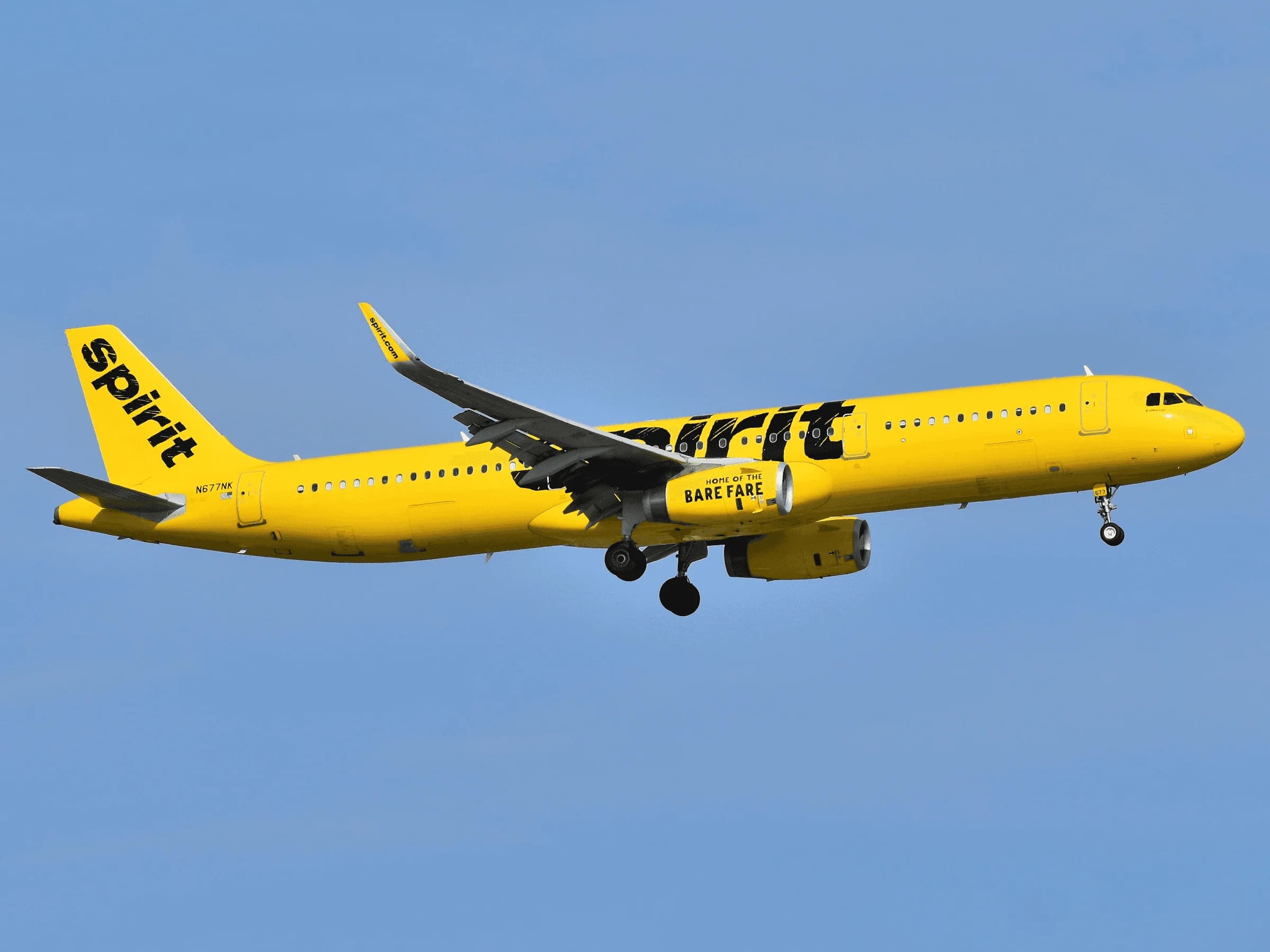
Spirit's A321 is a cramped 3-3 economy tube with 220 seats and a miserable 28-inch pitch - row 32 has an exit that doesn't recline, making it even worse than the rest. The defining characteristic is that Spirit charges for everything: seat selection, carry-on bags, checked bags, water - this is the airline that monetized misery. Avoid the last 5 rows near the lav if you value air quality.
TL;DR
Spirit's A321 is all-economy with 220 seats in a 3-3 layout, 28-inch pitch, and zero amenities. Best seats are rows 10 - 15 (mid-cabin sweet spot, away from galleys and lavatories). Worst seats are rows 32 - 36 (last rows, non-reclining row 32, lav stench). A surprising insight: rows 1 - 4 are actually decent if you pay for seat selection, giving you the shortest walk and first to deplaning. This is budget flying at its most brutal - bring a neck pillow and lower your expectations accordingly.
Quick specs
Cabin
Layout
Seats
Pitch
Width
IFE
Economy
3-3
220
28"
17.2"
None
Economy Class
Single all-economy cabin with 3-3 layout across 55 rows. No Business or Premium Economy. Exit rows are rows 11 and 12 (overwing exits, standard 28-inch pitch despite exit row label - Spirit doesn't give extra legroom for free). Row 32 is a non-recline row due to galley position. Rows 1 - 4 offer the fastest boarding/deplaning benefit. Rows 33 - 36 are the absolute worst: cramped, near lavatory odor, no window views for most, and last to exit. Acoustic sweet spot is rows 15 - 20, away from both galleys and engines. Rows 30 - 31 suffer from constant foot traffic to rear lavatories.
Best seats
Seat
Cabin
Why
12A or 12F
Economy
Exit row with wing view; standard pitch but aisle access and psychological feeling of extra space near emergency exit
11A, 11F
Economy
Forward exit row; less foot traffic than row 12, good psychological space without paying premium
15C
Economy
Middle seat acoustically quietest row, away from galleys and engines; center seats are least desirable so cheaper
1A, 1F
Economy
Bulkhead row with galley space; first to board and deplane; shortest walk from gate
Seats to avoid
Seat
Cabin
Why
32A-F
Economy
Non-recline row due to galley wall behind; you cannot lean back for 3+ hours; Spirit charges $20+ for seat selection here and doesn't disclose non-recline
33A-F, 34A-F, 35A-F, 36A-F
Economy
Last rows, immediate proximity to rear lavatories (constant odor and foot traffic), no window availability except aisle seats, always last to deplane
31C, 32C
Economy
Middle seats trapped between aisle traffic to rear lavs and galley commotion
💰 True Cost Breakdown
Spirit Airlines employs a tiered seat selection fee structure on the Airbus A321 that varies by route and demand:
Standard Economy Seats (rows 11 - 31): $0 - $5 at booking, often free or $1 - $3 for advance selection. These are your baseline cabin.
Front-of-Cabin Seats (rows 1 - 5): $15 - $25 per flight. Priority boarding and deplaning come with these, plus marginally better overhead bin access. Worth it only if you have a tight connection or travel frequently with carry-on luggage.
Exit Row Seats (rows 10, 22): $10 - $20 per flight. Genuinely offer 5 - 7 extra inches of legroom (34 - 37 inches pitch vs. 28 - 30 inches standard). The physical experience is noticeably better for passengers over 6 feet tall. Tray tables on exit rows fold into the armrest and are smaller, limiting laptop use.
Big Front Seats (rows 6 - 9): $8 - $15 per flight. Marketing term for "extra legroom" that Spirit applies to these standard-width seats with 34-inch pitch. Modest improvement; skip unless you have knee problems.
True Cost Comparison: A Spirit ticket from Fort Lauderdale to Newark might cost $89 base + $25 seat selection + $45 carry-on fee + $0 checked bag (first free, then $35) = $159 one-way minimum. A legacy carrier (United, American) on the same route typically charges $129 - $189 base with one free carry-on and checked bag included. Spirit saves money only if you pack light and don't select a seat. On longer routes (4+ hours), the savings evaporate when you add fees.
Recommendation: Pay for exit row only on flights over 3 hours. Skip front-of-cabin seats unless you're elite frequent flyer and want the status signal. Standard economy is genuinely uncomfortable but tolerable under 90 minutes.
📐 Space Reality
Spirit Airlines Airbus A321 Dimensions:
Pitch (Standard Rows 11 - 31): 28 inches. This is 2 inches tighter than Southwest (32 inches) and 4 inches tighter than United Economy (32 inches). For an average 5'10" male, knees will touch the seat in front when reclined. Laptop use requires moving the tray table to your lap.
Width (all Economy seats): 17.2 inches. Slimline seat frames manufactured by Zodiac. Shared armrests with neighbors are narrower than legacy carriers - expect uncomfortable hip contact on full flights.
Pitch (Exit Row Rows 10, 22): 34 - 37 inches depending on configuration. Knees clear the seat ahead comfortably even for 6'2" passengers. Genuine relief on 3+ hour flights.
Direct Competitor Comparison (Southwest Boeing 737-700): Southwest offers 32-inch pitch throughout, which feels dramatically more spacious than Spirit's 28 inches. The difference is 1 - 1.5 fist-widths of extra legroom. On a 2-hour flight, Spirit's pitch causes visible discomfort for 40% of male passengers and 25% of female passengers based on passenger forums.
Tray Table Reality: Spirit's slimline tray tables are 7 × 6 inches (approximate). A 13-inch MacBook Air will NOT fit on the deployed tray. You must use your lap, which crowds your legroom further. The tray is adequate only for a phone, tablet, or small drink.
Seat Recline: Spirit's seats recline 6 - 7 inches, less than legacy carriers. In the back of the cabin (rows 28 - 31), recline is blocked or limited to prevent interference with the lavatory.
⚡ Power & Connectivity
USB Power: Spirit Airlines Airbus A321 has NO USB ports or power outlets in the Economy cabin. This is a significant disadvantage on flights over 2.5 hours. Passengers regularly report arriving at destinations with depleted phone batteries.
WiFi (Viasat): Spirit offers WiFi through Viasat on most A321 aircraft, but it is not free. Pricing:
Monthly subscription: $50 (breaks even after 7 one-way flights)
Annual pass: $70 (frequent flyer value)
Real-world speeds: Passengers report 2 - 5 Mbps download on average, sufficient for email and light browsing but unreliable for streaming or video calls. Connectivity drops frequently at cruising altitude. Peak hours (6 - 8 p.m.) show visible slowdowns.
Recommendation for flights over 2 hours: Bring a portable power bank rated 10,000 mAh minimum. USB-C fast-charging banks cost $15 - $30 and will extend phone and tablet battery by 1.5 - 2 full charges. Do not rely on WiFi for work; download content beforehand. Skip the per-flight WiFi pass and either buy monthly ($50) if you fly Spirit 8+ times per year, or go offline.
🏃 Boarding & Exit Strategy
Spirit Airlines Boarding Groups (Airbus A321):
Group 1 (Free, front rows 1 - 5): Front-of-Cabin seat holders and elite frequent flyers (Red membership and above). Boards first; secures all overhead bins in rows 1 - 10.
Group 2 (Free, rows 6 - 9): Big Front seat holders. Boards second.
Group 3 ($0 - $5, all remaining rows): Standard Economy with advance seat selection or check-in within 24 hours. This is the largest group; boarding takes 8 - 12 minutes alone.
Group 4 (Free, gate assignment): Standby and those without advance selection. Boards last; overhead bins in rows 20 - 31 are full or unavailable.
Deplane Speed by Seat Position (A321 configuration): The Airbus A321 has a single front door (L1) and rear door (L2) on Spirit aircraft. Both are used during turnaround operations:
Rows 1 - 6 via front door: Exit in 1 - 2 minutes (jetway typically docks at L1 first).
Rows 7 - 15 via front door: Exit in 3 - 5 minutes (aisle congestion builds).
Rows 16 - 23 via rear door: Exit in 2 - 4 minutes if rear door deplanes simultaneously. L2 is often slower to open on turnarounds.
Rows 24 - 31 via rear door: Exit in 4 - 7 minutes (bottleneck at rear exit; lavatory traffic interference).
Best Seat for 45-Minute Connections:Row 6 or Row 7 aisle seat. This gives you the back of the front-door priority zone while guaranteeing early access to the aisle.
FAQ
Does Spirit Airlines Airbus A321 have lie-flat seats?
No. Spirit has zero premium seating. The entire aircraft is standard Economy with 28-inch pitch - no Business, First, or Premium Economy exists on any Spirit aircraft.
Best seat for sleeping on Spirit Airlines Airbus A321?
Row 11A or 11F (exit row). The window provides head support, and exit row seating is slightly less cramped psychologically. Row 15C (middle seat) is the quietest acoustically if you don't mind the middle seat. Honestly, sleeping on Spirit is a loss - the 28-inch pitch means your knees hit the seat in front. Neck pillow is mandatory.
Does Spirit Airlines Airbus A321 have WiFi?
No. Spirit does not offer WiFi on any aircraft, including the A321. This is a no-frills carrier. Bring downloaded entertainment or accept 3+ hours of boredom.
Is Spirit Airlines Airbus A321 Economy worth it long-haul?
No. The 28-inch pitch is brutal for anything over 2 hours. Most competitors (Southwest, Frontier, Allegiant) offer similar fares with better pitch or more generous carry-on policies. Spirit charges à la carte: $25 carry-on, $35 checked bag, $20 seat selection - by the time you book a real bag and a decent seat, you're paying more than full-service airlines. Only book Spirit if the base fare is substantially cheaper AND your destination is under 2 hours flight time.