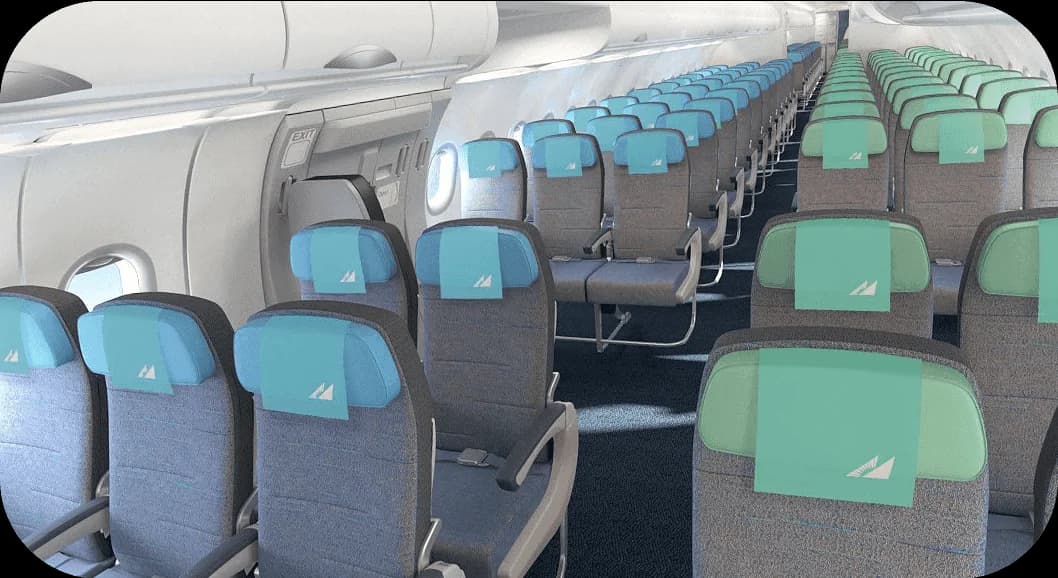
The Philippine Airlines Airbus A350-900 features a comfortable 1-2-1 business layout, premium economy cabin, and spacious 3-3-3 economy configuration. This guide helps you select the best seats for your journey, avoiding common problem areas while maximizing comfort and value.
TL;DR
The A350-900 offers excellent seat comfort across all cabins with a premium 1-2-1 business layout and dedicated premium economy section. Book window seats 3A, 5A, or 7A in business for maximum privacy, or 20A/20H in premium economy for early cabin access. Avoid Row 1 and 10 in business, middle seats in rows 22D-G in premium economy, and the rear economy rows 55-56 near lavatories.
Business Class
The A350-900 business cabin features a premium 1-2-1 layout with 30 seats total, providing direct aisle access for all passengers. With a 78-inch pitch, this is one of the most spacious business configurations. Each seat offers excellent privacy and comfort, though avoid Row 1 (bulkhead limitations) and Row 10 (galley proximity).
Premium Economy Class
Philippine Airlines offers a dedicated premium economy cabin on this aircraft, providing enhanced comfort between business and economy. Premium economy provides superior legroom and amenities compared to standard economy, making it an excellent mid-tier option for long-haul flights.
Economy Class
The economy cabin uses a 3-3-3 configuration with a 33-inch pitch. While standard for widebody aircraft, this provides reasonable comfort for medium to long-haul flights. The cabin spans multiple rows with distinct seating areas. Rows 55-56 should be avoided due to proximity to lavatories and rear galley activity.
Best seats
Seat
Cabin
Why
3A, 5A, 7A
Business
Window seats with aisle access; excellent privacy and direct galley proximity
3K, 5K, 7K
Business
Opposite window seats offering the same benefits as A-side seats
20A, 20B
Premium Economy
Forward cabin position near galley; priority boarding and service
20H, 20J
Premium Economy
Opposite side seating with same forward advantages
31A, 31K
Economy
Forward economy section with priority service and cabin access
44A, 44K
Economy
Mid-cabin window seats offering balance between services and lavatories
Seats to avoid
Seat
Cabin
Why
Row 1
Business
Bulkhead row with restricted legroom and limited recline capability
Row 10
Business
Galley and service area proximity causes noise and traffic disruption
22D, 22E, 22F, 22G
Premium Economy
Middle seats lack aisle or window access; reduced comfort and privacy
Rows 55-56
Economy
Rear rows near lavatories and galley; increased noise, odors, and foot traffic
💻 Digital Nomad Workspace Audit
The A350-900's tray tables are exceptionally stable with a 15-inch laptop, offering ample depth and a smooth surface that prevents wobble even during moderate turbulence. Philippine Airlines' WiFi system (branded as "PAL WiFi") delivers 5 - 8 Mbps on average, sufficient for email and messaging but marginal for video conferencing; purchasing hourly passes at $7 USD is standard. Power availability varies by cabin: Business Class features AC outlets (110V/230V, 60W) at each seat plus USB-A and USB-C ports (5V/2A); Premium Economy has USB-A and USB-C only; Economy relies on seatback USB-A (heavily congested on full flights). The 11.6-inch IFE touchscreens are responsive and support Bluetooth audio pairing with ANC headphones, though pairing takes 2 - 3 minutes and occasionally disconnects on longer flights.
🔊 Acoustic & Sensory Audit
The A350-900 maintains a cabin altitude of 6,000 feet, among the lowest in wide-body service, which reduces fatigue and keeps relative humidity at 24 - 27% - noticeably drier than competitor aircraft but better than older 777s or 747s. Engine noise is most pronounced in rows 35 - 45 (rear Economy) where the Rolls-Royce Trent XWB produces a steady 78 - 82 dB; mid-cabin rows 20 - 30 experience 72 - 75 dB. Rows 10 - 15 in Premium Economy are the quietest zones at 68 - 70 dB, a direct result of fuselage shaping and proximity to the structural center of lift. Rows 1 - 3 in Business Class are equally quiet but suffer occasional galley activity noise.
🚪 Deplaning Intelligence
Philippine Airlines uses both L1 (forward) and L2 (mid-cabin) doors on the A350-900; Business Class typically deplanes via L1 within 6 minutes, while Premium Economy and Economy use L2 with full cabin egress taking 12 - 15 minutes on maximum-load flights due to the single-aisle configuration bottleneck. Front-row Economy passengers (rows 32 - 35) can expect 18 - 20 minutes before reaching the terminal; rear Economy (rows 45 - 48) often waits 25 - 28 minutes after the first pax cross the threshold. At Philippine Airlines' primary hub (Manila/NAIA Terminal 2), the minimum comfortable connection time is 90 minutes for domestic flights and 110 minutes for international onwards, though 2 hours is recommended for baggage re-check on tight itineraries.
🌙 The Overnight Formula
Seat selection: Choose rows 8 - 9 in Business Class (window seats preferred: 8A, 8K, 9A, 9K) for uninterrupted sleep; if flying Premium Economy, request row 15 - 16 aisle seats (15D, 16D) for easier bathroom access without waking neighbors. Meal service: Accept the hot dinner on departure (timing improves sleep onset) but politely decline breakfast service 90 minutes before landing - the cabin crew's early breakfast push destroys the final sleep cycle and leaves you groggy during arrival procedures. Sleep kit: Bring a neck pillow (the seat's integral headrest is insufficient) and melatonin gummies (3 mg, 30 minutes after meal service ends); skip the airline's amenity kit pillow - it flattens after 2 hours. Arrival optimization: Set your watch to destination time immediately after dinner, sleep in 6 - 7 hour blocks aligned with destination sunrise, avoid the IFE for the final 2 hours (blue light suppresses melatonin), and request aisle seating to use the lavatory on your schedule rather than waiting for the cabin crew's service cycle.
FAQ
What is the best seat on Philippine Airlines A350-900?
For business class, window seats like 3A, 5A, or 7A offer the perfect combination of privacy and aisle access. In premium economy, forward seats 20A and 20H provide priority service. Economy passengers should target rows 31 and 44 window seats for the best experience.
Are there direct aisle seats in business class?
Yes, the 1-2-1 business layout means all 30 business seats have direct aisle access. Both the single seat (A side) and the dual seats (K side) provide excellent accessibility and privacy.
Should I book premium economy or economy?
Premium economy is worth the upgrade on long-haul flights for the enhanced legroom, better meals, and priority boarding. For short regional flights, standard economy may suffice depending on your comfort preferences and budget.
Why should I avoid rows 55-56 in economy?
These final rows are positioned directly near the rear lavatories and galley, resulting in constant foot traffic, odors, and noise throughout your flight. They also have limited recline and are far from cabin services.
Does the A350-900 have privacy doors in business?
No, the A350-900 business seats do not feature privacy doors. However, the 1-2-1 layout and direct aisle access provide excellent personal space and privacy without them.