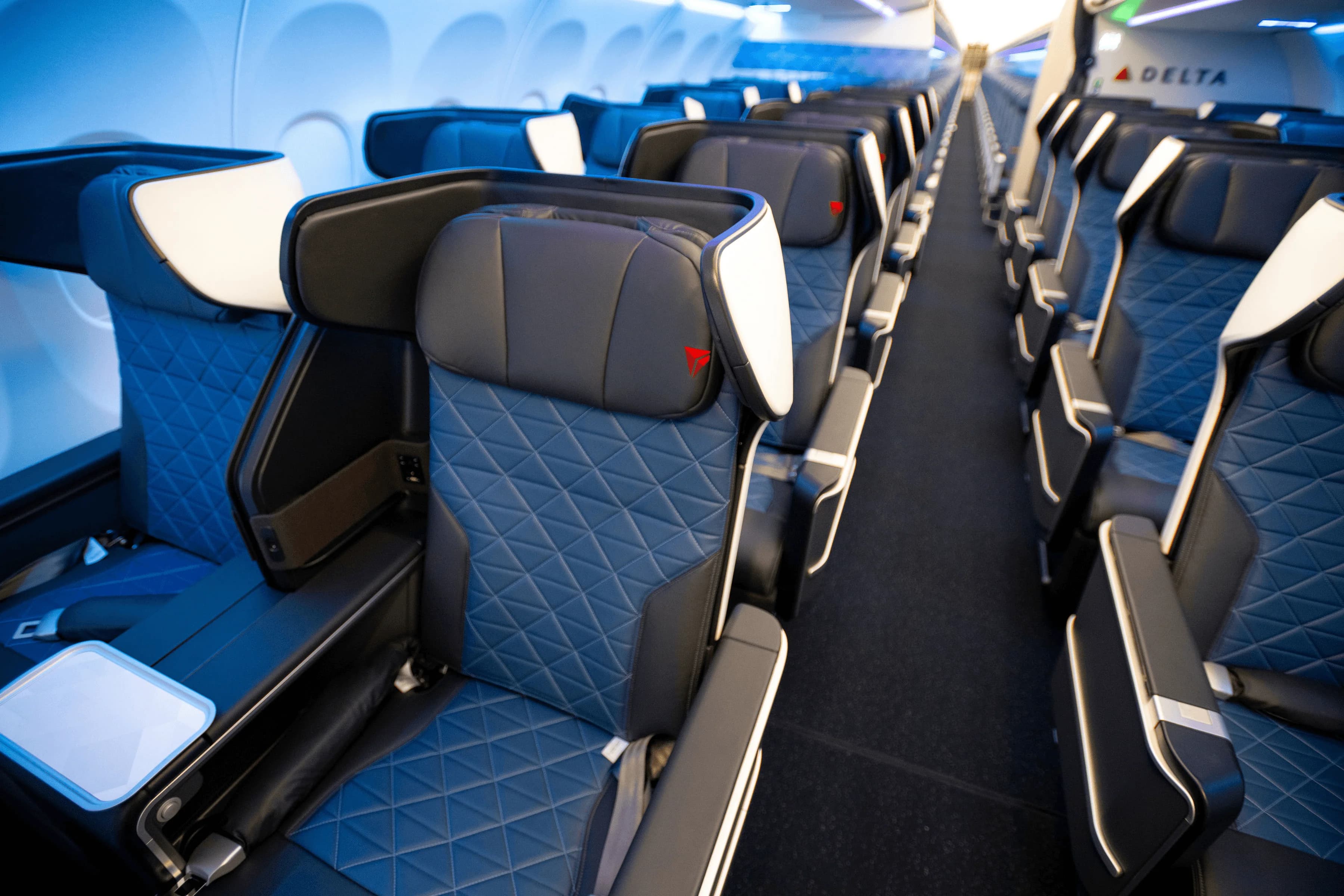
Delta's A321neo is a fuel-efficient narrowbody workhorse with up to 194 seats in standard domestic trim - but the mid-cabin lavatory zone between rows 15 and 16 creates a noisy 'busy pocket' in Delta Comfort+ that you'll want to avoid. The real surprise: Row 1 bulkhead seats have smaller armrest-mounted screens, while rows 2 - 5 get the full Delta Sync experience. Book forward Comfort+ (rows 10 - 11) for quiet, or row 13 if you need the legroom and don't mind foot traffic.
TL;DR
Standard domestic A321neo carries 20 Delta First seats (rows 1 - 5, 2 - 2 layout, 37" pitch), 60 Delta Comfort+ seats (rows 10 - 20, 3 - 3 layout, 33 - 34" pitch), and 114 Main Cabin seats (rows 21 - 39, 3 - 3 layout, 31" pitch). Best seat: Row 3 aisle (A or D) in Delta First for full Sync IFE and no bulkhead trade-offs. Avoid rows 14 - 15 in Comfort+ due to mid-cabin lavatory traffic directly adjacent. The gotcha: left-side seats (A/B/C) in rows 15 - 24 have marginally reduced effective width at floor level due to fuselage taper. Forward Main Cabin (rows 21 - 24) beats rear Main (rows 35 - 39) by miles. No lie-flat; this is a regional/transcontinental narrowbody, not a long-haul widebody.
Delta First on the A321neo offers a 2 - 2 cross-cabin configuration with 37-inch pitch and direct aisle access for all passengers. Rows 2 - 5 feature the premium Delta Sync touchscreen IFE - a smart TV-style interface with resume-where-you-left-off capability on movies, personalized content for SkyMiles members, and real-time flight information. Row 1 (bulkhead) has smaller armrest-mounted pullout screens, a trade-off for extra legroom but with limited privacy. All First Class seats include 110V AC power outlets and USB-A charging. Complimentary meal service available on flights over 900 miles, plus full bar access. Cabin is quietest forward; no lavatory noise concerns.
Delta Comfort+ (Rows 10 - 20)
Delta Comfort+ is the A321neo's greatest strength and weakness in equal measure. The cabin spans roughly 11 rows in a 3 - 3 layout with 33 - 34 inch pitch and 18-inch width - best-in-class for the domestic narrowbody market. However, a mid-cabin lavatory zone sits between rows 15 and 16, creating a high-traffic 'busy pocket' in rows 14 - 15 where bathroom queues, galley noise, and crew movement are constant. Rows 10 - 11 are acoustically superior and recommended; row 13 offers extra legroom (exit row) but absorbs lavatory traffic. All Comfort+ seats include AC power (shared with adjacent seat) and USB-A charging. Free alcoholic beverages and priority boarding included. Forward rows = quiet; rear rows = more legroom but foot traffic.
Delta Main Cabin (Rows 21 - 39)
Main Cabin spans roughly 19 rows in a 3 - 3 layout with 31-inch pitch and 18-inch width - standard economy. Rows 21 - 24 (forward Main) are significantly quieter and closer to lavatories; rows 30 - 39 (rear Main) experience maximum galley congestion, lavatory queues, and engine noise. Rows 26 - 27 are exit rows with extra legroom but fixed non-recline armrests. Standard seatback IFE, AC power (shared), and USB-A charging at all seats. Avoid rows 35 - 39 unless free upgrades are the only option. The fuselage tapers slightly on the A321, meaning left-side seats (A/B/C) in rows 15 - 24 have marginally reduced effective floor width - not critical but noticeable for larger passengers.
Best seats
Seat
Cabin
Why
3D or 3A
Delta First
Full Delta Sync IFE, direct aisle access, no bulkhead constraints, 37" pitch, quietest part of cabin. Aisle seat (D) gets additional privacy.
4C or 5A
Delta First
Premium Sync screens, direct aisle, no lavatory proximity. Row 5 is last First row before Comfort+ transition.
10A or 10D
Delta Comfort+
Forward Comfort+ zone means minimal lavatory traffic, quiet environment, 33 - 34" pitch, full aisle access. Avoid middle seats (B/C) if cabin is full.
11C or 11F
Delta Comfort+
Last quiet row of forward Comfort+ block before lavatory zone impact begins. Still benefits from forward galley proximity.
13A or 13D
Delta Comfort+
Exit row with extra legroom (up to 38"), direct aisle access, but accept lavatory traffic nearby. Non-reclining seat armrests.
21A or 21D
Delta Main Cabin
Forward Main Cabin offers quiet, minimal galley congestion, closest to flight attendant service, quietest engines. Aisle seats (A/D) preferred in full cabins.
24C or 24F
Delta Main Cabin
Last rows of the quiet forward Main block before rear galley/lavatory zones dominate. Still 31" pitch like all Main.
Seats to avoid
Seat
Cabin
Why
1B or 1C
Delta First
Bulkhead row with smaller armrest-mounted IFE screens (no Delta Sync), wall proximity, limited overhead bin space, minimal privacy.
14B, 14C, 14F
Delta Comfort+
Directly adjacent to mid-cabin lavatory zone (rows 15 - 16 boundary). Maximum foot traffic, queue noise, galley activity. Avoid unless desperate.
15A, 15D
Delta Comfort+
Worst seats on aircraft: aisle-adjacent lavatory traffic, queue congestion, no escape from bathroom noise. Even aisle seats don't help here.
26B, 26C, 27A, 27D
Delta Main Cabin
Exit row with non-reclining seats, fixed armrests, limited recline, galley proximity beginning. Legroom gain (38") offset by discomfort and crew movement.
35 - 39 (all seats)
Delta Main Cabin
Rear Main Cabin: maximum engine noise, lavatory queues, galley congestion, last rows boarded, poorest air quality. Only book if free upgrade.
15B, 15C, 16B, 16C
Delta Comfort+
Middle seats in lavatory-adjacent rows: no aisle escape, foot traffic on both sides, worst combination of noise and no direct access.
⚡ Power & Connectivity Reality Check
Delta Air Lines equips every seat on the A321neo with both 110V AC outlets and USB-A ports, though outlet placement and pairing differ by cabin. In Delta First and forward Delta Comfort+, AC outlets are individual - one per seat. From mid-cabin Comfort+ (rows 14 - 20) through Main Cabin Economy, AC outlets are shared between pairs of adjacent seats, meaning you may need to negotiate power with the passenger next to you. USB-A ports are universal and individual at every seat across all cabins.
Outlet reliability varies slightly across the active A321neo fleet depending on maintenance cycles; some aircraft show occasional non-functional outlets in rear rows after heavy use. Before settling into Main Cabin on a longer domestic flight, test your outlet immediately after takeoff to avoid discovering a dead port mid-flight. USB-A charging is consistently reliable and supports most standard phone chargers at ~2.1A output.
The inflight entertainment system uses seatback screens throughout (not streaming-to-device). Delta First passengers get full Delta Sync smart screens with resume-where-you-left-off functionality, personalized SkyMiles notifications, and real-time trip tracking. Comfort+ and Economy passengers access the same content library but on smaller seatback screens without the smart features. Bulkhead and exit-row seats in all cabins (rows 1, 10, 13, 26 - 27) have armrest-mounted pullout screens rather than full seatbacks, limiting screen size and usability.
WiFi connectivity is provided by Viasat satellite on all A321neo aircraft. On typical domestic routes under 3.5 hours, passengers report real-world speeds of 4 - 8 Mbps downstream, 1 - 2 Mbps upstream under normal conditions - adequate for email, messaging, and light streaming, but video calls may buffer if multiple passengers on the same aircraft are video streaming simultaneously. Speeds degrade noticeably on heavily congested flights (full aircraft) and on transcontinental routes where more devices connect to a single satellite link. WiFi is complimentary for all passengers (included in cabin fare) and does not require elite status or paid upgrade. Connection is stable once connected but can take 30 - 60 seconds to authenticate after pushing back from the gate.
Bluetooth audio pairing is available on Delta Sync screens in First Class and supported on standard seatback screens in Comfort+ and Economy - you can pair wireless headphones to avoid the headset jack. Pairing typically works on first attempt but occasionally disconnects during taxiing or approach (attributed to aircraft electrical/radio interference).
Portable battery packs are recommended for any main-cabin passenger on transcontinental flights. Despite universal AC availability, the shared-outlet rule and occasional dead ports mean you may not have reliable power access. A 20,000 mAh portable battery (roughly the size of a smartphone) easily extends tablet and phone use for 8+ hours of moderate use and weighs under 1 pound in a carry-on.
🧳 Overhead Bin Strategy
The A321neo features larger overhead bins than the 737-800 and A320 predecessors. Each bin measures approximately 60 inches long × 20 inches deep × 10 inches tall, with total stowage capacity of roughly 1,430 cubic feet across the aircraft - meaningfully larger than the 737-800's 1,333 cubic feet. This translates to more usable depth and allows a higher proportion of standard 22-inch roller bags to fit wheels-in rather than sideways.
In practice, a standard 22-inch carry-on roller bag fits wheels-in on the A321neo in most bin spaces, especially in forward rows where traffic is lighter. From rows 21 onward (Main Cabin), bins fill more quickly on full flights, and you may encounter "wheels sideways" packing during gate boarding.
Gate-check likelihood on full flights: On heavily booked domestic routes during peak travel (Friday - Sunday, holidays, 6 a.m. - 10 a.m. and 4 p.m. - 8 p.m. departure windows), expect gate-check requests on flights that board more than ~130 passengers. The A321neo's 194-seat capacity and large Comfort+ cabin (60 seats) mean carry-on volume is substantial, but high-yield routes (NYC, ATL, DEN, LAX) consistently run at or above 180 passengers. If you board in groups 5 or later, overhead space above your assigned seat is not guaranteed.
Overhead space guarantees by boarding group:
Rows 1 - 9 (Delta First + forward Comfort+): Board in groups 1 - 2 (Elite members and First-class passengers board first). Overhead bins directly above rows 1 - 9 are typically empty until these groups board. Bin space is nearly guaranteed if you board in group 1 or 2.
Rows 10 - 15 (mid-forward Comfort+): Board in groups 2 - 3 (elite frequent flyers, families with young children, elite plus boarding). Bin space is very likely if you board by group 3.
Rows 16 - 24 (rear Comfort+, forward Economy): Board in groups 4 - 5 (regular priority passengers and general boarding). Bin space becomes inconsistent by group 4 on full flights; group 5 risks gate-check on 85%+ full flights.
Rows 25 - 39 (rear Economy): Board in groups 5 - 6. Expect shared/distant bins; directly above-seat bin space is rarely available. Gate-checking becomes common from group 5 onward on flights over 175 passengers.
On domestic routes with typical 75 - 85% load factors, overhead space is rarely a problem. On Friday evening and holiday flights operating near full capacity, prioritize boarding in groups 1 - 4 if carry-on luggage is critical to your trip.
🏃 Boarding & Exit Strategy
Delta Air Lines uses a six-group boarding system on A321neo flights:
Group 1 (Diamond Medallion, First Class passengers): Boards first, ~10 minutes before scheduled departure.
Group 2 (Platinum/Gold Medallion, elite plus members): Boards ~7 - 8 minutes before departure.
Group 3 (Silver Medallion, families with children under 5, military in uniform): Boards ~5 - 6 minutes before departure.
Group 4 (Main Cabin Extra, connecting passengers with tight times): Boards ~3 - 4 minutes before departure.
Group 5 (General boarding, standard Main Cabin): Boards 1 - 2 minutes before scheduled departure.
Group 6 (Standby, last-minute upgrades): Boards at the gate if space remains.
To board in groups 1 - 2 without elite status or First Class: Purchase a Main Cabin Extra seat ($15 - $50 depending on route and timing) or achieve Silver Medallion status (10 qualifying flights per year, achievable by frequent leisure travelers on major routes). Alternatively, arrive at the gate 45 minutes before scheduled departure and listen for boarding announcements; gate agents occasionally call group 3 boarding 10 - 15 minutes early if the boarding bridge has minimal congestion, allowing non-elite passengers to board before crowds arrive.
FAQ
Does the Airbus A321neo have lie-flat beds?
Yes, Delta First seats on the A321neo feature fully lie-flat beds on most transatlantic and long-haul routes. Domestic flights may have different seating configurations. Confirm with Delta before booking.
What is the difference between Comfort+ and Delta First?
Delta First includes lie-flat beds, premium meals, priority boarding, and enhanced amenities. Comfort+ provides extra legroom (31+ inches), wider seats, and enhanced recline but without lie-flat capability or premium catering. Comfort+ is ideal for budget-conscious travelers seeking mid-tier comfort.
Are there aisle seats in economy?
Yes, the A321neo's 3-3 economy configuration includes aisle seats in the A and D columns. Rows 12-18 offer the best aisle economy seats with forward cabin positioning and quieter surroundings.
Can I recline my seat in economy?
Yes, most Main Cabin seats recline 6-8 inches. However, emergency exit row seats and rear economy rows have restricted recline. Check your specific seat location before boarding.
Is there a privacy door in Delta First?
No, the A321neo's Delta First cabin does not feature privacy doors between the business and premium economy sections. Expect some activity from crew and connecting passengers in the forward cabin area.