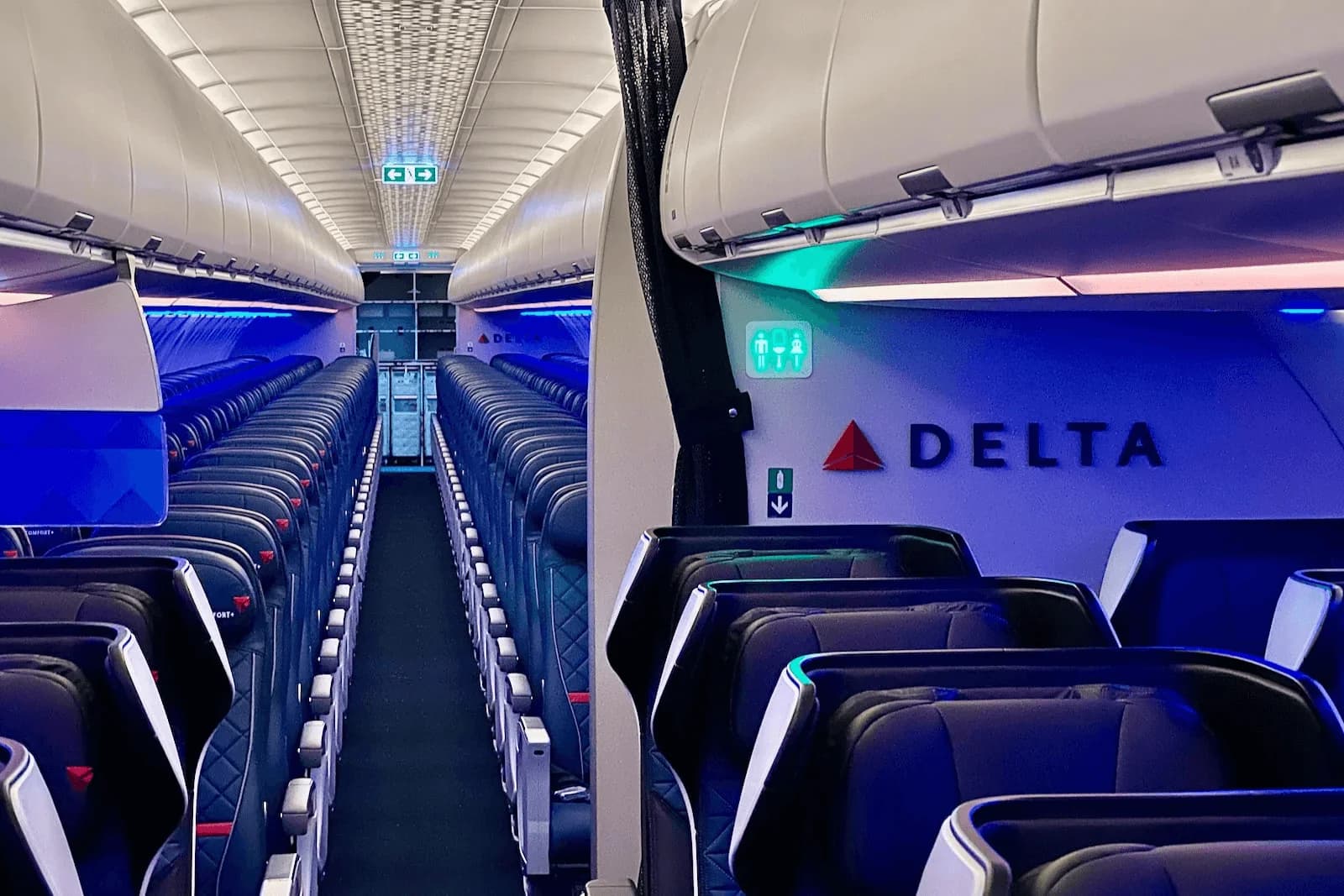
Delta's A321neo is a domestic tech powerhouse featuring "privacy wings" in First Class and 4K screens in every row. Learn why Row 12 is a windowless trap and how to find the best legroom.
TL;DR
Delta's A321neo carries 20 First Class seats in a 2-2 layout and 169 Main Cabin seats in a 3-3 layout, with Comfort+ occupying the forward Main Cabin rows and exit rows. The aircraft has seatback IFE screens at every seat, Viasat Wi-Fi, and USB-C charging throughout - a meaningful step up from the older 737-800. Best seats: First Class rows 2-4, Comfort+ exit rows. Worst: last row, and the no-recline row directly in front of the exit.
Delta Air Lines operates the Airbus A321neo on domestic routes from its Atlanta, New York JFK, Los Angeles, and Seattle hubs, as well as select Caribbean and short-haul international services. The A321neo is progressively replacing older narrowbodies - particularly the MD-88 and 717 - on routes where a modern, efficient 190-seat narrowbody is the right capacity tool.
First Class
Delta First Class on the A321neo is a 2-2 layout with 20 seats across 5 rows. Seat width is 21 inches - slightly wider than the equivalent First Class on the older 737-800. Pitch is 39-41 inches depending on the row. The seat reclines to approximately 40 degrees - this is a domestic recliner product, not lie-flat. IFE screens are 13.3 inches - sharp and responsive with Delta's standard domestic entertainment library. Bluetooth audio pairing is built in.
Row 1 deplanes fastest but is adjacent to the forward galley - more noise during pre-departure drink service and meal prep. Rows 2-4 are the acoustic sweet spot within First Class. Row 5 (the last First Class row) backs onto the Comfort+ bulkhead - occasional foot traffic from Economy passengers approaching the bulkhead and light bleed from the cabin behind on full flights. Mid-cabin rows 2-4 window seats are the standout First Class positions.
Comfort+
Delta Comfort+ on the A321neo occupies the forward Economy rows directly behind First Class and the exit rows. Pitch is 34 inches - 4-5 inches more than standard Main Cabin. The seat hardware is the same Recaro slimline design as standard Main Cabin, so the upgrade is positional. The exit row Comfort+ seats are the standout positions - extra pitch plus the exit door space creates near-unlimited legroom. The bulkhead Comfort+ row (first row behind First Class divider) has the most pitch in Comfort+ but no under-seat storage during takeoff and landing.
Main Cabin
Main Cabin on the A321neo is a 3-3 layout at 30-31 inches of pitch. Every seat has a 10.1-inch seatback IFE screen - not the streaming-to-device system on older Delta narrowbodies, but a proper seatback screen with Delta's full content library. USB-C charging at 60W is standard at every seat. Viasat satellite Wi-Fi supports streaming video reliably on most routes - a genuine improvement over the older Gogo air-to-ground system on legacy aircraft.
The no-recline row immediately in front of the exit should be specifically avoided - it has Comfort+ pitch but cannot recline, which is a poor trade on any flight over 2 hours. The last row has no recline, rear galley noise, and lavatory proximity. The window pair seats (A and C on the left, D and F on the right) in the forward Main Cabin provide the fastest access to the exit and the clearest path to overhead bin space during boarding.
The A321neo vs 737-800 on Delta
Delta operates both the A321neo and the 737-800 on competitive domestic routes. The A321neo advantages for passengers: consistent seatback IFE at every seat (vs streaming-to-device on some 737-800 configurations), USB-C charging at every seat, LEAP-1A engines that are measurably quieter than the CFM56 on the 737-800, and larger overhead bins that reduce gate-check frequency on full flights. The seat product in First Class and Comfort+ is effectively identical between the two types. For Main Cabin passengers, the A321neo's IFE and charging infrastructure are the meaningful practical differences.
💻 Workspace audit
First Class features a stable tray table with a wide surface adequate for a 15-inch laptop. Viasat Wi-Fi is standard across Delta's A321neo fleet - consistently rated as one of the more reliable domestic US inflight internet options, supporting video calls and large file transfers. USB-C at 60W at every seat means no need for a separate adapter or battery pack on routes under 5 hours.
Best seats
Seat
Cabin
Why
Row 2-4 A or D
First Class
Mid-First window seats. Away from forward galley noise. Full recline. Quietest First Class position.
Exit row Comfort+ A or F
Comfort+
Maximum legroom on the aircraft below First Class. Worth booking at ticketing.
Forward Main Cabin A or F (rows 8-12)
Main Cabin
Window seats in the acoustic sweet spot. Fast deplaning relative to rear cabin.
Seats to avoid
Seat
Cabin
Why
Non-recline row (in front of exit)
Comfort+/Main Cabin
Restricted recline to keep the exit path clear. Check seat map for specific row number.
Last row all positions
Main Cabin
No recline, rear galley noise, lavatories directly adjacent.
Row 5 First Class
First Class
Last First Class row. Comfort+ bulkhead foot traffic and light bleed on full flights.
FAQ
Does Delta A321neo have seatback screens in every seat?
Yes. Delta's A321neo is equipped with seatback IFE screens in all cabins - 13.3 inches in First Class and 10.1 inches in Main Cabin - with Delta's full domestic entertainment library. This distinguishes it from older Delta narrowbodies that use streaming-to-device systems.
What is the aircraft code for Delta's A321neo?
The booking code is 32Q for Delta's A321neo. This appears in your booking confirmation and distinguishes it from the older A320 and A319 in Delta's fleet.
Is Delta First Class on the A321neo lie-flat?
No. The A321neo First Class is a domestic recliner product at approximately 40 degrees - not lie-flat. Lie-flat Delta One is only available on international widebody aircraft.
Does Delta A321neo have USB-C charging?
Yes. 60W USB-C is standard at every seat across all cabins - First Class, Comfort+, and Main Cabin. This allows laptop charging without a separate AC adapter.