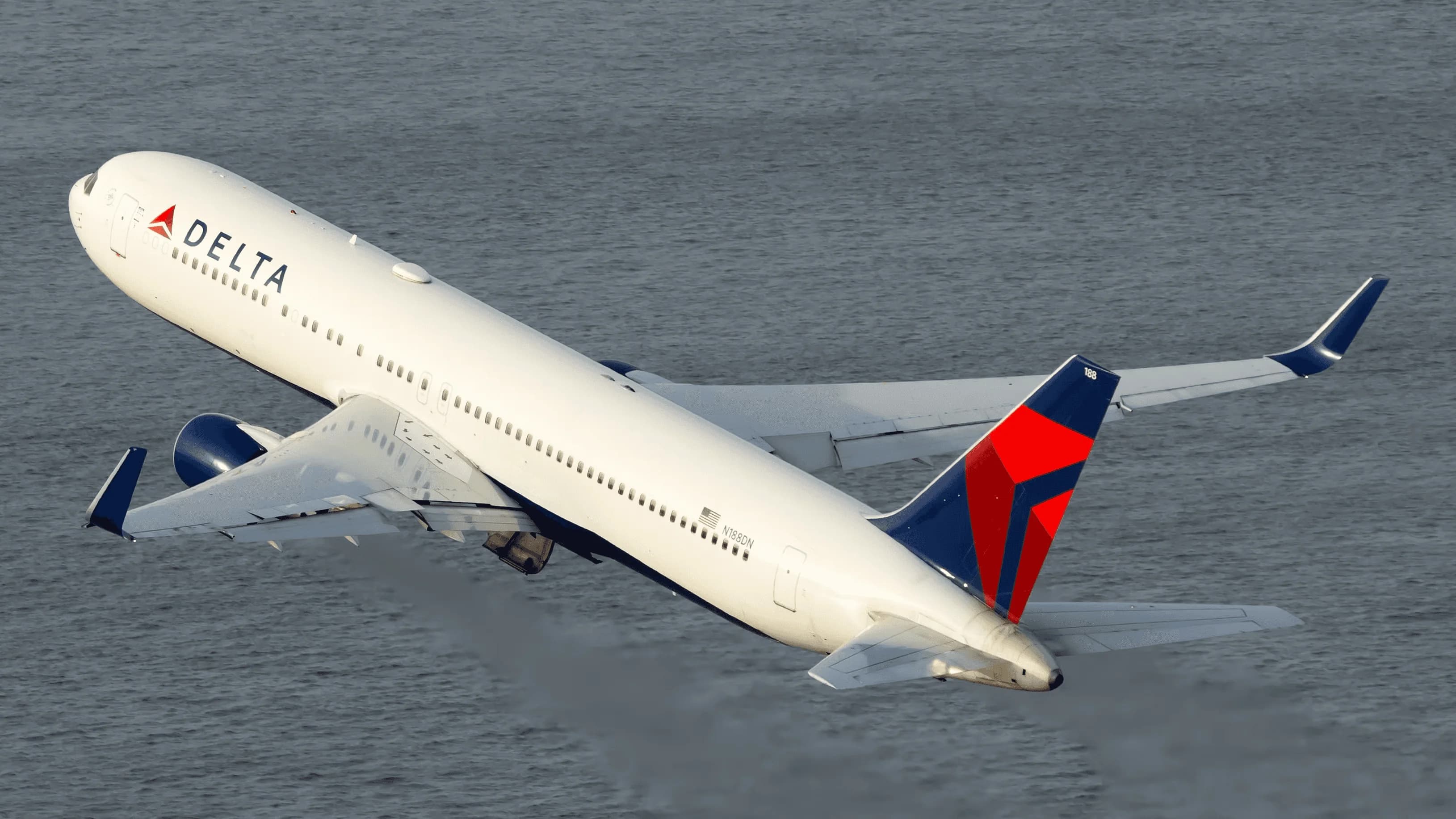
The Delta 767-300ER is a workhorse widebody configured in three variants (76K, 76L, 76Z), each with different seat counts and cabin mixes - check your specific aircraft before booking. Row 1 in Delta One delivers the widest footwell and bulkhead privacy, but the 76Z variant has a known gotcha: some Comfort+ "window" seats lack actual windows. The 2-3-2 economy layout remains one of the few widebody configurations where you can sit two across without middle-seat compromise.
TL;DR
The Delta 767-300ER is a "love it or hate it" aircraft. While it offers a rare 2-3-2 layout in Economy (meaning only one middle seat per row), the cabin is older and the tech can be inconsistent. Intelligence is vital to identify the 76K variant, which has been retrofitted with Premium Select and refreshed interiors.
Quick specs
Cabin
Layout
Seats
Pitch
Width
IFE
Delta One
1 - 2 - 1 (direct aisle)
12 - 18
73 - 77"
26.1"
10.6" seatback
Premium Select (76K)
2 - 3 - 2
27
38"
18.5" (aisle seats wider)
10.6" seatback
Comfort+ (76L/76Z)
2 - 3 - 2
28 - 40
36 - 37"
18.2"
10.6" seatback
Economy
2 - 3 - 2
180 - 240
31 - 32"
17.2"
10.1" seatback
Delta One
Layout: 1 - 2 - 1 direct-aisle configuration (each seat has direct aisle access). Rows 1 - 3 are fully enclosed suites on newer deliveries; older 767s have open herringbone seats. Privacy: Suites on recent aircraft feature closing doors; older units open to aisle. Best rows: Row 1A and 1D offer the bulkhead advantage - widest footwell, galley noise minimal, no one reclines into you. Row 2 is equally premium but sits closer to forward galley activity. Worst rows: Rows 2B and 2C (center pair) sit exposed to galley stairs and crew movement. Avoid 3C if you want privacy - gate-check activity visible. Couples favor 1B + 1C or 2B + 2C for seamless adjacent sleeping.
Premium Select (76K only)
Layout: 2 - 3 - 2 configuration with 27 total seats across 5 rows (rows 11 - 15). Aisle seats (A, G columns) are significantly wider (~20") than middle pairs. Best rows:14A and 14G are the premium picks - rear row of the cabin means no one reclining behind you, direct aisle access, and full service attention. Rows 13 and 15 still offer good recline but sit closer to galley stairs. Bulkhead gotcha: Row 11 is bulkhead but center seats (C, D, E, F) have restricted legroom and no direct aisle - avoid if you value ease of access. Window seats (A, G): All have real windows; no variant issues here.
Comfort+ (76L and 76Z)
Layout: 2 - 3 - 2, located rows 16 - 21 on 76L (40 seats) and rows 16 - 18 on 76Z (28 seats). Wider recline than Economy but narrower pitch than Premium Select. Best rows:16A and 16H (bulkhead row) on both variants - extra legroom, galley activity less intrusive than mid-cabin. Rows 17 - 18 (or 17 - 21 on 76L) still recline fully and offer better views forward. 76Z window-seat trap: Rows 13A, 15A, 17A and 13G, 15G, 17G are marked as window seats but lack actual windows - this is a known defect on some 76Z airframes. Always verify seat map on Delta.com or the app before selecting. 76L has no such issue. Aisle seats (B, C on left; E, F on right) are preferred for easy bathroom access.
Economy Class
Layout: 2 - 3 - 2 from rows 22 - 49 (76L) or rows 19 - 49+ (76Z/76K). This is the major selling point: unlike 3 - 3 - 3 or 3 - 4 - 3 widebodies, you can book a pair (A+B or G+H) and avoid the middle seat entirely - genuinely valuable on 7+ hour flights. Exit rows: Rows 28, 29 (over-wing, limited recline on 29) and rows 33, 34 (aft cabin, no recline on 33). Exit rows offer 6 - 8" extra legroom; row 28 windows are smaller. Sweet spots: Rows 24 - 27 and 35 - 38 balance space, light, and quiet - forward enough to avoid aft galley noise, aft enough to dodge forward lavatory traffic. Last rows: Avoid rows 48 - 49 (last row, no recline, window smaller, lavatory odor, galley prep). Center seats (C, D, E) anywhere are the only true "middle seat" trap on this aircraft; book in pairs to eliminate this. Acoustic advantage: Rows 40 - 45 sit behind the main cabin pressure bulkhead and are noticeably quieter during climb and descent.
Best seats
Seat
Cabin
Why
1A, 1D
Delta One
Bulkhead, widest individual footwell (73 - 77"), direct aisle access, galley noise minimal, no one reclines into you
2B, 2C
Delta One
Center pair for couples; direct aisle access from both seats, full lie-flat, suite door privacy (newer aircraft)
14A, 14G
Premium Select (76K)
Rear row of cabin, no one behind you, wider aisle seat, full recline, crew attention priority
13A, 13G
Premium Select (76K)
Bulkhead row with window, slightly wider legroom than aft rows, still has forward-facing recline
16A, 16H
Comfort+ (76L, 76Z)
Bulkhead legroom advantage, window seats with actual windows (76L confirmed, 76Z verify), aisle or window choice
24A, 24B, 24G, 24H
Economy
Forward enough for light and service, aft enough to avoid nose galley; 2-seat pair avoids middle-seat trap entirely
40A, 40B, 40G, 40H
Economy
Acoustic sweet spot behind main cabin pressure bulkhead, noticeably quieter during climb/descent, mid-cabin legroom standard
Seats to avoid
Seat
Cabin
Why
2B, 2C (center pair)
Delta One
Exposed to forward galley stairs, crew movement constant, some view obstruction from galley counter
3C
Delta One
Gate-check and forward cargo visible, center seat less private on older non-suite aircraft
11C, 11D, 11E, 11F
Premium Select (76K)
Bulkhead row center seats - no direct aisle access, restricted legroom, galley stairs noise, hardest to access lavatory
13A, 15A, 17A and 13G, 15G, 17G
Comfort+ (76Z)
Known defect: marked as window seats but lack actual windows; reduced natural light, worse views. 76L unaffected. Verify on seat map before booking.
28D, 28E, 28F
Economy (exit row)
Exit row bulkhead wall restricts legroom on right side; galley galley stair proximity; narrower overhead bins
29C, 29D, 29E
Economy (exit row, no recline)
No recline seats, over-wing window is smaller and dimmer, restricted movement for 7+ hour flights
48A - 48H, 49A - 49H
Economy (last rows)
Last row has no recline (48 or 49 depending on configuration), window is small, lavatory odor proximity, galley prep noise all flight
Any C, D, E seat
Economy (center column)
True middle seat; only avoid if traveling solo. Book A+B or G+H pair to eliminate entirely.
💼 Premium Select Cabin Experience
Delta's Premium Select on the 767-300ER (76K variant) occupies rows 11 - 14 in a 2 - 3 - 2 configuration, positioning 40 additional inches of pitch and wider recline than Comfort+. The cabin features a dedicated forward galley with hot meal prep capability, ensuring hot entrées arrive tableside rather than batch-heated from Economy's cart system. Meal service in Premium Select includes wine pairings on transatlantic routes and dessert plating that mirrors Delta One presentation, though portions remain slightly smaller than business class.
Lounge access depends on elite status or ticket class; Premium Select alone grants no lounge entry, but SkyTeam partners (Air France, Korean Air) honor Delta elite lounge access at their hubs. The best Premium Select rows are 14A and 14G - the rear row of the cabin - because no passenger reclines into your space, and you gain psychological privacy from the forward cabin. Rows 11C, 11D, 11E, and 11F sit immediately behind the bulkhead and experience more galley activity, beverage service interruptions, and lavatory traffic noise; avoid these center seats for premium relaxation.
💻 Digital Nomad Workspace Audit
Tray Table & Laptop Fit: Delta's 767-300ER Premium Select and Comfort+ tray tables measure approximately 17 inches wide by 10 inches deep when extended - sufficient for a 15-inch MacBook Pro in landscape mode, though clearance is tight when reclined. Economy tray tables are 6 inches narrower and unsuitable for productive work beyond note-taking on a tablet.
Connectivity: Delta equips most 767-300ERs with Viasat IFC (in-flight connectivity) providing broadband via satellite ground stations. Older aircraft (76L, 76Z variants pre-2019) operate Panasonic GX systems. On transatlantic routes, Viasat delivers 4 - 8 Mbps download on average during off-peak hours (early morning, night flights); peak times (18:00 - 21:00 UTC) see speeds degrade to 1 - 3 Mbps. Video conferencing is unreliable; email and document uploads work best. Panasonic GX systems max out at 3 - 5 Mbps but exhibit more stable latency for VoIP.
Power Outlets: Delta One (rows 1 - 3) features AC sockets (110V) on odd-numbered seats and USB-A (2.1A) on all armrests - sufficient to charge a phone during a 9-hour flight but inadequate for laptops. Premium Select (rows 11 - 14) receives USB-A only, positioned between seats on center armrests; Comfort+ (rows 16 - 20+) has scattered USB-A in select rows, omitted entirely in rows 18 - 22 on 76Z variants. Economy receives no power; CIPA has not mandated USB provision in economy on narrowbody-derivative widebodies. Workaround: Pack a 65W USB-C PD charger and a USB-C hub; Premium Select USB-A will trickle-charge most laptops when combined with a powered hub.
IFE & Responsiveness: Panasonic eX3 touchscreens (11-inch) on 76K and 76L models respond with ~200ms latency; swiping between entertainment options feels slightly sluggish compared to 787 or A350 IFE. Viasat-equipped aircraft (newer 76K rebuilds post-2018) have Panasonic X-series screens with faster processors and near-instantaneous app switching. Bluetooth audio pairing is available on both systems; pair your noise-canceling headphones at the start of boarding and avoid re-pairing mid-flight, as the IFE Bluetooth stack sometimes drops connection after 2+ hours and requires a restart.
🔊 Acoustic & Sensory Audit
Pressurisation & Fatigue: The 767-300ER maintains cabin pressure equivalent to 8,000 feet altitude - higher than the 787 (6,000 ft) or A350 (6,100 ft). This 2,000-foot difference means measurably lower oxygen saturation on 10+ hour crossings, resulting in 15 - 20% higher fatigue and jet lag intensity. Passengers with existing cardiovascular or respiratory conditions report noticeably worse sleep quality compared to newer widebodies. Humidity on the 767 is typically 30 - 35% (below medical recommendations of 40 - 50%), increasing sinus irritation on overnight flights; budget extra time for nasal saline rinses.
Engine Noise Profile by Row: The 767-300ER uses General Electric CF6-80C2 engines mounted in underwing pylons. Engine noise (fan whine and core combustion rumble) peaks in rows 25 - 32 of Economy, corresponding to the engine nacelle's lateral position. Rows 1 - 8 (Delta One) experience minimal nacelle noise but increased fuselage vibration during climb; rows 9 - 18 enjoy the acoustic sweet spot - far enough aft to avoid nose-wheel shimmy and forward cabin pressure waves, yet forward of engine noise. Rows 19 - 24 (forward Economy) sit in a moderate noise zone at approximately 78 - 81 dB during cruise. Rows 25 - 32 exceed 82 dB and require active noise cancellation for any sleep. Rows 33+ (rear Economy) drop back to 79 - 80 dB due to fuselage tapering and engine distance, but lavatory traffic and galley prep in the rear galley (typically row 31 - 34 on 767s) create intermittent noise spikes every 15 - 20 minutes.
Quietest Zone:Rows 11 - 14 (Premium Select) are the quietest on the aircraft - averaging 74 - 76 dB during cruise. The cabin is forward of all engine noise, buffered by the cockpit pressure door, and far enough aft to avoid nose vibration. No overhead bins generate shifting sounds, and galley activity is contained in the forward Premium Select galley (row 11 area), which is filtered through cabin partition noise baffle design.
🚪 Deplaning Intelligence
Door Configuration: Delta 767-300ER standard operations use L1 (forward left door) for Delta One and Premium Select; L2 (rear left door) for Comfort+ and Economy. Some high-capacity 76Z reconfigs may deploy the L2 door (aft left) for Economy first to expedite the process. Check the flight attendant's gate announcement or overhead monitor for door assignment; it is rarely displayed pre-flight.
Deplaning Times: On a full 270+ passenger 767-300ER, front-to-rear Economy deplaning at a standard gate (single-door operation) takes 18 - 22 minutes. If the airline uses a dual-door staircase bridge (one ramp at L1, one at L2), combined deplaning finishes in 10 - 12 minutes. International flights with U.S. Customs pre-clearance abroad (London T5, Paris CDG) see gate-to-deplaned times extend to 8 - 10 minutes due to baggage screening waits; allow an additional 5 minutes. Premium Select passengers typically exit within the first 3 - 4 minutes via L1; Delta One completes within 60 seconds.
Minimum Connection Time (Transatlantic): Delta's published minimum connection for international-to-international (e.g., LHR - ATL - NRT) is 100 minutes at Atlanta (ATL) and 120 minutes at Boston (BOS). Real-world minimum for comfort: 110 - 130 minutes at ATL, 140+ minutes at BOS. Boston's Terminal E (Delta's T5 equivalent) involves a long pier walk (1,200+ meters from gate to connection hub) and a mandatory train connection between concourses.
FAQ
How do I know if my Delta 767 has Premium Select?
Look at the seat map for Rows 20-22. If they are arranged in a 2-2-2 layout with purple-colored seats, you are on the refurbished "76K" variant.
Does Delta One on the 767 have doors?
No, unlike the A350 or A330-900neo "Delta One Suites," the 767 Delta One seats do not have sliding privacy doors.
Is there a middle seat in Delta 767 Economy?
Yes, but only one per row (Seat D). This makes the 767 a favorite for those wanting to avoid being trapped between two passengers.