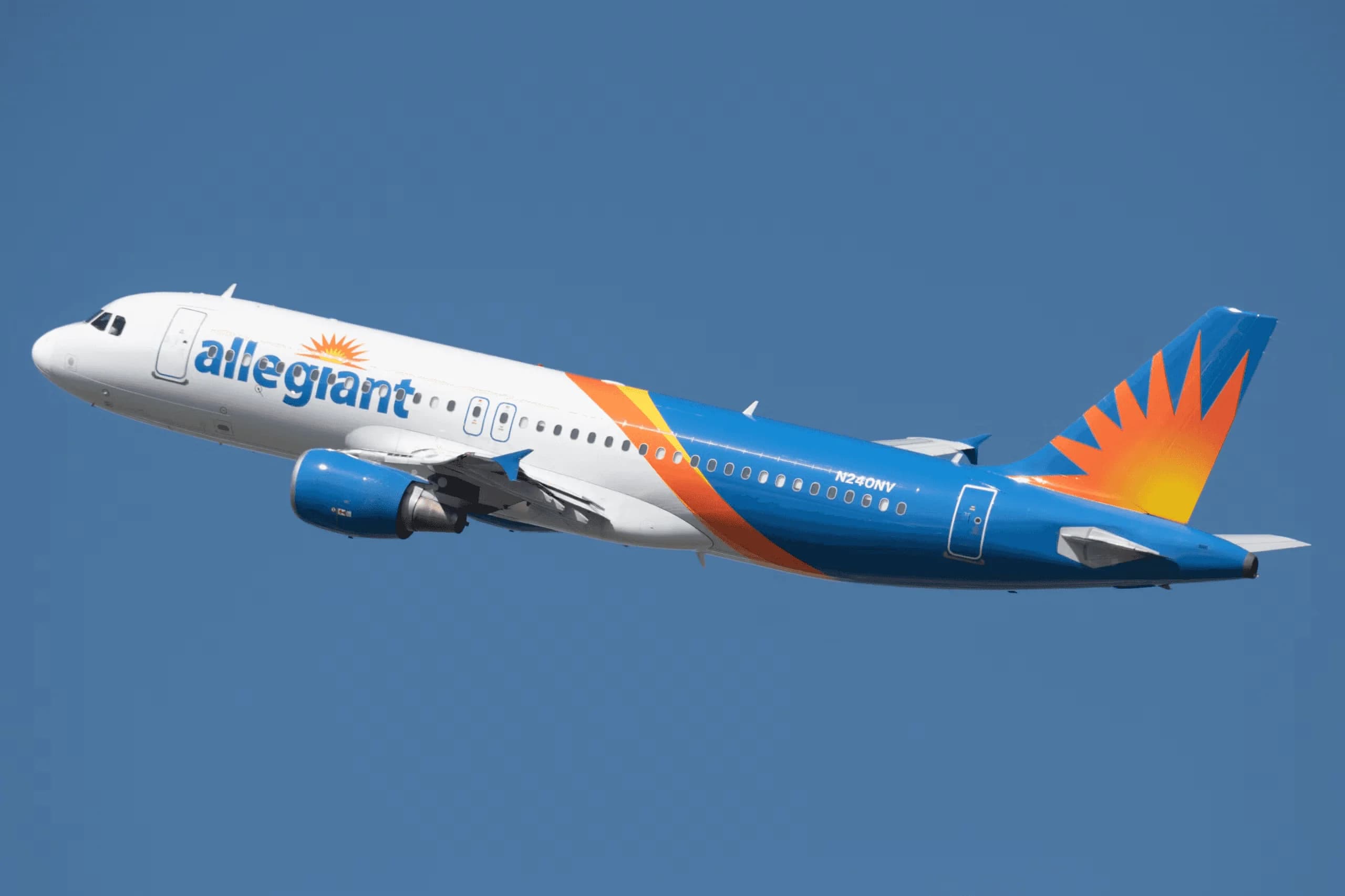
Allegiant Air operates an all-economy Airbus A320 with a 3-3 cabin layout and ultra-low fares to match. Understand seat pitch variations, premium legroom options, and which seats offer the best value on this ultra-low-cost carrier.
TL;DR
The A320 is configured entirely in economy with standard 28 - 30 inch pitch and slimline seats. Allegiant Extra rows 1 - 5 offer ~34 inches of pitch for a premium fee. Best seats are 2A and 2F (window legroom+ with underseat storage) or exit rows 12 - 13 for maximum legroom. Avoid row 1 middle seats (1B, 1E) due to no underseat storage, armrest tray tables, and proximity to galley and lavatory.
Cabin Layout
The Allegiant Air Airbus A320 is configured as a single-class, all-economy aircraft with a 3-3 seating arrangement across 180 seats. There is no business or premium economy cabin; all passengers travel in standard economy conditions.
Economy Class
All seats are economy with slimline seats and standard 28 - 30 inch pitch. Allegiant offers an optional upgrade to Allegiant Extra, which provides approximately 34 inches of pitch and is available for rows 1 - 5. Standard underseat storage applies, though row 1 middle seats (1B, 1E) have restricted access. Exit rows 12 - 13 provide additional legroom regardless of booking class, making them a valuable option if available at your fare level.
Best Seats
Seat
Cabin
Why
2A
Economy
Window seat with Legroom+ pitch; direct aisle access and full underseat storage
2F
Economy
Window seat with Legroom+ pitch; direct aisle access and full underseat storage
12A - 12F
Economy
Exit row seats with extra legroom; optimal comfort for tall passengers
13A - 13F
Economy
Exit row seats with extra legroom; optimal comfort for tall passengers
Seats to Avoid
Seat
Cabin
Why
1B
Economy
Middle seat with no underseat storage; armrest-integrated tray table; adjacent to galley and lavatory
1E
Economy
Middle seat with no underseat storage; armrest-integrated tray table; adjacent to galley and lavatory
💰 The True Cost Breakdown
Allegiant charges $15 - $25 per segment for "Advance Seat Selection" on preferred seats (exit rows and forward cabin), while standard economy seats remain free if booked at check-in. Front-row seats (1A - 1F and 10A - 10F) command the highest premium at $25, exit rows (rows 11 - 12) run $15 - $20, and everything else is included with your base fare. Compared to legacy carriers like American or Delta, Allegiant's a-la-carte model can save money if you're flexible with seat choice, but choosing preferred seats across a round-trip can add $60 - $100 to your ticket - still cheaper than legacy seat fees but noticeable on ultra-low fares.
📐 The Space Reality
Allegiant's A320 features 28 - 30 inch pitch (legroom) and 17.2 inch width seats, making it tighter than Spirit Airlines' comparable 28 inch pitch but nearly identical to Frontier's slimline configuration. The narrower seat cushion and reduced recline (2 - 3 inches) mean you'll feel the squeeze if you're above average build, especially on cross-country flights; the tray table is minimal and won't reliably fit a 13-inch laptop in landscape mode without folding it partially. Overhead bin space is standard for an A320, so carry-on luggage competes heavily during busy flights.
⚡ Power & Connectivity Reality Check
Allegiant does not offer in-seat power outlets or USB charging ports on any A320 seats, so a fully charged external battery pack is essential for flights over 2 - 3 hours. The airline does not provide complimentary WiFi; paid WiFi options (typically $5 - $7 per hour or $20 monthly passes) are available but real-world speeds are inconsistent and often slow due to network congestion. Plan to arrive with 50%+ battery remaining, as even purchased WiFi is unreliable for streaming or video calls on cross-country routes.
🏃 Boarding & Exit Strategy
Allegiant uses an open seating model with zone-based boarding, where rows are called in groups; purchased "Advance Boarding" ($10 - $15) gets you into an earlier zone. For fastest deplaning on an A320 with dual doors (front and rear), aisle seats in rows 6 - 9 offer the quickest egress to either door, while back-of-cabin seats (rows 25+) mean a long walk even though they empty last. If you have a tight connection, skip premium seating and choose an aisle seat in the forward-to-mid cabin (rows 1 - 8) where you'll board early and exit quickly, saving 3 - 5 minutes versus a rear seat.
FAQ
Does Allegiant Air Airbus A320 have business class?
No. Allegiant operates this aircraft as a single all-economy cabin with no business or premium economy product.
What is Allegiant Extra?
Allegiant Extra is an optional upgrade available for rows 1 - 5 that provides approximately 34 inches of seat pitch (compared to 28 - 30 standard) and is marketed as premium legroom. It is available for an additional fee at booking.
Are exit row seats worth booking?
Yes. Exit rows 12 - 13 offer significantly more legroom than standard economy and are ideal for passengers over 6 feet tall. They may incur a seat selection fee depending on your fare type.
Why avoid row 1 middle seats?
Row 1 middle seats (1B, 1E) have no underseat storage, feature armrest-integrated tray tables (less convenient), and are positioned adjacent to the galley and lavatory, resulting in noise and foot traffic.
Can I store luggage under the seat in row 1?
Row 1 middle seats (1B, 1E) have restricted underseat storage. Window and aisle seats in row 1 retain standard underseat storage access.