Air India's Airbus A350-900 offers a premium long-haul experience with direct aisle access in Business Class and a spacious three-cabin configuration. This guide reveals the best and worst seats across all cabins.
TL;DR
The A350-900 features a 1-2-1 staggered Business Class layout with 28 fully flat beds, Premium Economy, and standard Economy in a 3-3-3 configuration. Seek window seats in Business Class for privacy (1A, 1F, 2C, 2J) and avoid rear Economy rows due to proximity to galleys and lavatories. The aircraft's advanced cabin pressure and humidity systems make even Economy more comfortable than comparable aircraft.
Business Class
Air India's Business Class on the A350-900 features a coveted 1-2-1 staggered layout with 28 fully flat beds spanning 48 inches pitch and converting to 180-degree sleep mode. Each seat offers 22 inches of width and direct aisle access on one side, ensuring privacy and easy lavatory access. Seats are arranged in an alternating window-aisle-window pattern, eliminating middle seats entirely. The sophisticated cabin includes advanced in-flight entertainment, USB-C charging, and enhanced cabin ambiance with dynamic lighting.
Premium Economy Class
Air India equips this A350-900 with a dedicated Premium Economy cabin featuring enhanced legroom, wider seats, and improved amenities compared to standard Economy. Passengers enjoy priority boarding, superior meal service, and greater recline capacity in a more intimate cabin environment.
Economy Class
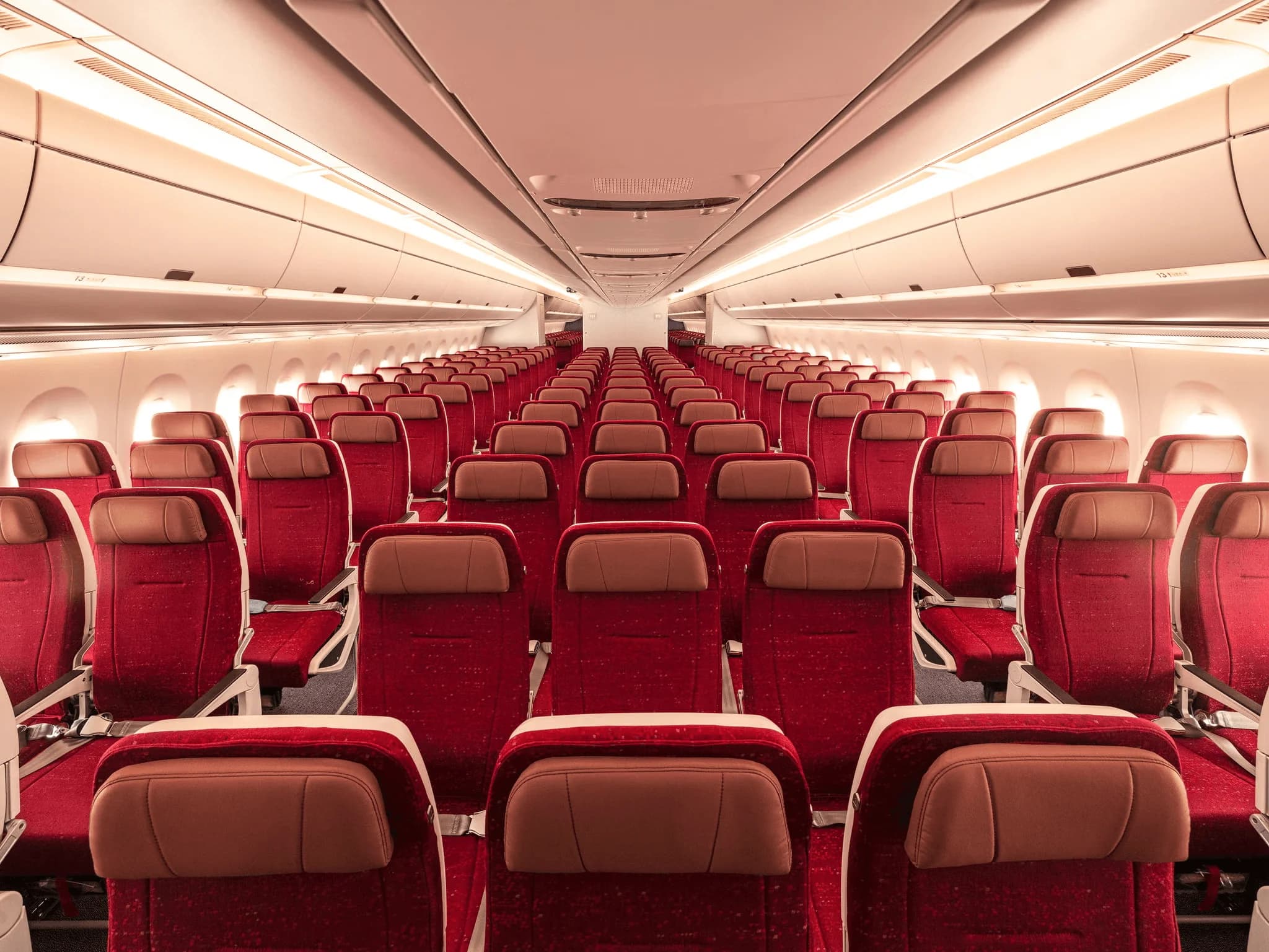
Standard Economy operates in a 3-3-3 configuration with 31-inch pitch and 17.5-18 inch seat width. The Airbus A350's advanced cabin pressure system (maintains 6,000 feet equivalent altitude instead of typical 8,000 feet) significantly reduces fatigue. Seat-back entertainment is standard, and USB power is available at most seats. The cabin's superior humidity control (maintained at 27% compared to industry standard 10-15%) provides additional passenger comfort on long flights.
Best seats
Seat
Cabin
Why
1A, 1F
Business
Window seats with direct aisle access and maximum privacy; excellent for rest on long-haul flights
2C, 2J
Business
Preferred window seats in second row, same privacy benefits with slightly less first-row foot traffic
11A, 11K
Premium Economy
Mid-cabin window seats offering optimal balance of views and reduced noise from rear galleys
25A, 25K
Economy
Forward Economy window seats minimizing lavatory odors and foot traffic
Seats to avoid
Seat
Cabin
Why
47-50 (rows)
Economy
Proximity to rear lavatories creates odor and noise; limited recline and galley congestion
Middle seats (all rows)
Economy
No direct aisle access; cramped experience in 3-3-3 configuration
28, 29
Business/Economy boundary
Potential noise and movement between cabin classes; inconsistent service timing
Over-wing exits (rows 24-26)
Economy
Fixed windows limit views and cabin feels more enclosed despite slightly wider seats
💻 Digital Nomad Workspace Audit
Business Class seats feature stable 18-inch tray tables that accommodate 15-inch laptops with minimal flex, though the fully-flat bed mode eliminates workspace functionality. Air India's Vistara WiFi operates on 5GHz dual-band at ~15 Mbps download speeds, adequate for email but insufficient for video conferencing. Power outlets vary by cabin: Business Class offers both AC power (110V/220V switchable) at each seat plus USB-A ports (5W); Economy features USB-A only. IFE screens measure 16 inches in Business Class with full Bluetooth audio pairing for wireless headphones.
🔊 Acoustic & Sensory Audit
The A350-900 maintains a pressurized cabin altitude of 6,000 feet with 24% humidity - notably superior to legacy widebodies at 8,000 feet - reducing fatigue on long-haul routes. Engine noise concentrates over the wing (rows 20-35 in Economy), with Business Class seats forward of row 10 experiencing minimal turbine vibration. The quietest rows are 1-4 in Business, positioned ahead of the main cabin noise path, while rear Economy (rows 45-50) suffers cumulative noise from engines, galleys, and lavatories. Mid-fuselage positions (rows 12-18) offer balanced acoustics for Economy sleepers.
🚪 Deplaning Intelligence
Air India A350-900 operates dual forward doors: L1 (Business Class primary) and L2 (rear Business/forward Economy). On a full 348-seat flight, Business passengers deplane in 8-12 minutes via L1, while Economy rear passengers require 22-28 minutes from L2 opening. At Air India's primary hubs (Delhi, Mumbai), minimum connection time for domestic onward flights should be 90 minutes for checked baggage transfers, though 120 minutes guarantees stress-free connections given varying gate distances.
🌙 The Overnight Formula
For overnight routes, book seats 1A or 1K (Business Class forward row, window positions with door shade control) - these avoid lavatory foot traffic and cockpit noise. Accept the light meal service 90 minutes post-departure to reset circadian rhythm, then request crew block all service until 6 hours pre-arrival. Bring a weighted eye mask, neck pillow, and compression socks; the A350's low-cabin-altitude environment reduces swelling but gradual pressure equalization aids sleep quality. Set your phone to arrival timezone immediately, request a forward galley seat if unavailable, and aim for 5-6 uninterrupted sleep hours by declining the pre-landing service.
FAQ
Is the A350-900 a comfortable aircraft for long-haul flights?
Yes. The A350-900 features industry-leading cabin pressure and humidity systems that reduce jet lag and fatigue. Even Economy passengers benefit from the aircraft's advanced environmental controls, which maintain cabin pressure equivalent to 6,000 feet altitude and humidity at 27% - significantly better than competing aircraft.
What is the advantage of the 1-2-1 Business Class layout?
The 1-2-1 staggered arrangement ensures every passenger has direct aisle access and a window seat, eliminating middle seats entirely. This provides superior privacy, easier lavatory access, and a more exclusive cabin experience compared to 1-2-1 non-staggered configurations.
Can I recline in Economy on this aircraft?
Yes, Economy seats recline approximately 6-8 inches, standard for long-haul aircraft. The 31-inch pitch is competitive for Economy, and the A350's superior cabin environment compensates for standard recline limitations.
Which seats have the most legroom in Economy?
Exit row seats (typically rows 24-26) offer additional legroom but may have restricted window views and fixed windows. Bulkhead seats (row 25) provide excellent legroom but may have overhead bin restrictions. Standard forward Economy rows (25-30) balance comfort and amenities.
Are there any seat width differences across cabins?
Business Class seats are 22 inches wide, while Economy ranges from 17.5-18 inches. Premium Economy falls between these dimensions with approximately 19-20 inches, offering a substantial comfort upgrade for long-haul routes.
How many passengers does the A350-900 typically carry on Air India routes?
The A350-900 configuration typically accommodates 28 Business, approximately 24 Premium Economy, and 262 Economy passengers, totaling around 314 seats in a three-cabin layout.