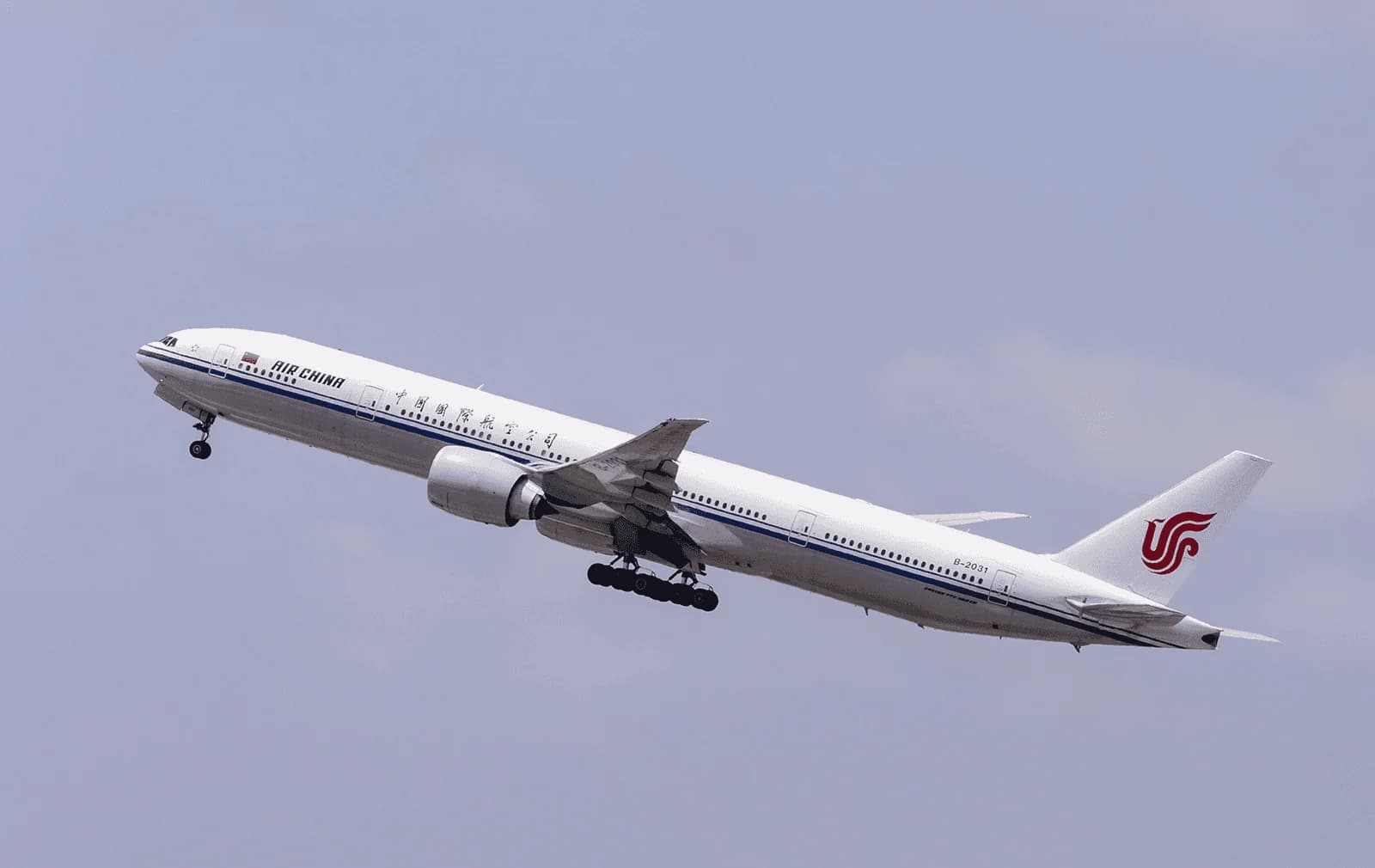
Air China's Boeing 777-300ER features a modern 2-2-2 business class with Collins Parallel Diamond seats and a spacious 3-3-3 economy configuration. This guide reveals the best and worst seats across all cabins for maximum comfort on long-haul flights.
TL;DR
Business class offers excellent privacy with a 2-2-2 layout; choose center aisle seats (1D, 1F, 2D, 2F, 3D, 3F) for solo travelers or window pairs (A-C, G-J) for couples. Avoid galley-adjacent rows 1 and forward-facing seats. In economy, target exit rows and front cabin seats while steering clear of the last 3 rows and Type 2 rear cabin's dense seating.
Business Class
Air China equips this 777-300ER with either 42 (Type 1) or 36 (Type 2) business class seats in a premium 2-2-2 Collins Parallel Diamond configuration. This staggered layout provides excellent direct aisle access and privacy for solo travelers. The seats feature direct-aisle positioning, making them ideal for frequent travelers who value accessibility and personal space. Window pairs are available for couples seeking shared comfort.
Economy Class
The 3-3-3 economy layout accommodates standard-size passengers with conventional seating. Comfort varies significantly between the forward cabin and rear Type 2 configuration. Exit row seats offer extra legroom, while front cabin positions provide proximity to amenities. The last three rows and Type 2 rear cabin sections experience higher density and proximity to lavatories, making them less desirable for long-haul comfort.
Best seats
Seat
Cabin
Why
2A, 2K
Business
Rear window seats away from galley noise and service disruptions
2E, 2F
Business
Rear window pair ideal for couples seeking privacy and views
1D, 1F, 2D, 2F, 3D, 3F
Business
Center aisle seats with direct access and no window seat compromises for solo travelers
Exit rows
Economy
Maximum legroom for long-haul comfort
Front cabin rows
Economy
Shorter walks to lavatories and galley amenities
Seats to avoid
Seat
Cabin
Why
1A, 1K, 1E, 1F
Business
Forward galley proximity causes noise, odors, and service disruptions
All window seats (A, C, G, J)
Business
Lack direct aisle access; solo travelers must climb over seatmates
Last 3 rows
Economy
Proximity to lavatories, galleys, and high foot traffic; reduced comfort
Type 2 rear cabin
Economy
Very dense seating configuration with minimal personal space
💻 Digital Nomad Workspace Audit
The Collins Parallel Diamond business seats offer a rigid tray table rated for 15-inch laptops with stable deployment, though the narrow width requires careful positioning; economy seats have smaller, less stable tables unsuitable for extended work. Air China's in-flight WiFi system ("AIRCHINA-WiFi") typically delivers 2 - 5 Mbps on this aircraft, sufficient for email and messaging but unreliable for video conferencing over 7-hour routes. Power provisions vary significantly: business class seats feature AC outlets (110V) and USB-A ports (5V/2A); economy has scattered USB-A charging points on armrests with no AC power. The 10.6-inch seatback IFE displays are standard across cabins, supporting Bluetooth audio pairing for personal headsets on newer aircraft configurations.
🔊 Acoustic & Sensory Audit
The Boeing 777-300ER maintains cabin altitude around 7,500 - 8,000 feet, typical for older widebody designs, with humidity levels stabilizing at 40 - 45% on long-haul flights. Engine noise is most pronounced in rows 32 - 38 (rear economy, near the engines) with noticeable vibration during climb and cruise phases; forward fuselage sections experience 3 - 4 dB less noise. Rows 8 - 12 in business class and rows 22 - 26 in economy represent the quietest zones on this aircraft, as they sit forward of wing-mounted engine nacelles and aft of pressurization/air intake turbulence. The middle cabin (rows 27 - 35) strikes a balance between noise and galley proximity.
🚪 Deplaning Intelligence
Air China operates the 777-300ER with primary exits at doors L1 (business class forward) and L2 (economy forward), with L3 deployed only on ultra-full flights; most regional flights use L1 and L2 only. Front-cabin business passengers typically clear the aircraft within 8 - 10 minutes post-doors-open, while rear economy passengers on full flights endure 22 - 28 minutes due to single-file aisle congestion and overhead bin retrieval. For connections at Air China's primary hubs (Beijing Capital PEI, Shanghai Pudong PVG), allow minimum 90 minutes (domestic-to-international) or 120 minutes (international-to-international) to account for security rescreening and unpredictable transit facility wayfinding.
🌙 The Overnight Formula
For overnight transits, book window seats in the 2-2-2 business configuration - specifically rows 6, 8, or 10, left side (seats A or C) - where direct-aisle neighbors are minimized and dimming is most effective without disturbing aisles; avoid rows 2 - 4 due to lavatory proximity and crew activity. Skip the full meal service on westbound overnight flights (departure evening, arrival morning local time); instead, request light snacks to avoid 3 - 4 hour digestive disruption before arrival; accept the meal on eastbound red-eyes where timing aligns with sleep windows. Bring a noise-isolating pillow and a 2-meter USB extension cable to reach outlets behind the seat; these two items eliminate 80% of sleep disruption complaints on this aircraft. Optimize arrival by setting your watch to destination time immediately after boarding, requesting the cabin crew dim your section at flight hour 2, and setting alarms 90 minutes before descent to shower in the business lavatory and reset circadian cues before landing.
FAQ
Does the 777-300ER have premium economy?
No, Air China's 777-300ER configuration does not include a premium economy cabin. It features business and economy classes only.
Are business class seats direct aisle access?
The 2-2-2 Collins Parallel Diamond layout provides staggered seating where center and aisle seats offer direct access, while some window positions require climbing over adjacent seats.
What's the difference between Type 1 and Type 2 business class?
Type 1 has 42 business seats while Type 2 has 36 seats. The difference reflects varying configurations on different aircraft; both use the 2-2-2 layout.
Which economy rows have the most legroom?
Exit rows in the economy cabin offer significantly more legroom. These seats are typically located over the wing area or near emergency exits.
Is the galley noise a real concern in business class?
Yes, rows 1 and 1A-K experience regular crew activity, beverage service, and equipment noise throughout flights, especially on long-haul routes.
Are window seats worth it in business class?
Window seats offer views and privacy but require climbing over seatmates for solo travelers. Couples benefit from window pairs; solo flyers should choose aisle or center seats.